IT'S ABOUT TIME TO GET IT TOGETHER
Chapter 1 - Family
I have much to say about my family members in the rest of this autobiography. However, I want to use this first chapter to help you understand who my family members are and how their interactions shaped my current capacity for intimacy and communication. I will describe my parents, Jack and Ida Aronowitz; my two wives, Judi Aronowitz (nee Wuntch) and Linda Piester; and my four children, Lisa, Scott, Cami, and Jeffrey.
I was born an only child in Philadelphia, Pennsylvania, on October 6, 1937. My parents and I moved to Wilmington, Delaware, when I was 6, and that's where I grew up.
My parents
From what I hear, many peopl e in psychotherapy explore how their parents were responsible for their current emotional difficulties and relationship hurdles. However, I do not remember ever blaming my parents for any of the problems that brought me off and on into 15 years of therapy. My childhood was challenging, like most, but not traumatic.
My father and I never had much to say to each other, but there was little animosity. I found him helpful and generally supportive. He built me a very useful bookshelf and desk that stretched across one wall of my bedroom. He installed a punching bag in our cellar to help me learn to defend myself. My favorite recollection is a wise, supportive statement he made when I was doing extremely poorly in college. I told him I was giving up my plans to be a dentist. He said, “Don’t worry about it. There’s more dentists than people got teeth in their mouths.” His simple language came from going to school only through the third grade. My father was a man of few words, as was I. He died suddenly at the age of 65 when I was 33 years old.
Our most troubling encounter happened one evening when I had just arrived home during college. My father wanted me to hang around for a while so I could say hello to his friends who were coming over for a card game. Instead, I wanted to go out with my friends. I was about to leave when my father said, “If you leave, don’t come back.” I was shocked, but I stayed because I knew my father could be resentful and stubborn. Although I had never personally experienced my father’s vindictiveness firsthand, I believed my father was capable of that kind of behavior. A family story from before I was born taught me that.
From what I heard, he had an argument with my mother’s sister’s husband. My mother had said that they wanted to set a wedding date. Her sister said, “You can’t get married until Papa says so.” My father said, “The hell we can’t.” My future uncle responded, “You can’t talk to my wife that way.” My father shouted, “I’ll talk to her anyway I want,” and provocatively picked up a chair. Although they were frequently in each other’s presence for the next 40 years, those were the last words they ever said to each other. I wrote a sonnet after my father died that referenced the event; I called it “Lamentation.” If you wish to read it, click here.
I didn’t have much to say to my mother either, which was regrettable. She had a way of saying things that were unique and interesting. When she was 84, while I was entering a nursing home to visit her, I heard her shout, “She’s treating me like a piece of wood.” The attendant was pushing her wheelchair on its back wheels. On another occasion, after my second very unusual wedding. I asked her how she liked it. She said, “It left me cold.”
She didn’t like being in a nursing home. I would usually find her sitting in the ever-present assembly of stationary wheelchairs in the hall. Usually, the first words I’d hear as I arrived were “I want to go home.” I would generally say, dismissively, “You are home.” I didn’t take what she said to be a statement of preference. I heard it as an accusation that I had somehow failed her by getting her into a nursing home. I never told her about my discontent, and I never learned the depths of hers.
But one regrettable night, she was not sitting out in the hall. She was not yelling. She did not say she wanted to go home. She was lying quietly in bed.
“What’s up?” I asked as I entered her room.
“I’m going to die,” she answered.
“Of course, of course, we all die,” I replied.
“No . . . I . . . am going to die.”
“But you have so much to live for,” I said, my head tilting toward the family photographs on her wall.
She didn’t reply, didn’t even look up, but closed her eyes and began to hum, her fingers tapping the mattress to the throb of the Yiddish tunes I had put into the tape player next to her bed.
“Are you remembering the day we circle danced around your bed to that music?” I asked, but she didn’t respond.
“Don’t you remember?” I insisted. She shrugged.
“What are you thinking?” I asked.
“My father.”
“What about him?”
“I used to sing for him.”
“Yiddish songs?”
“He’d pick me up on the dining room table to sing”.
“Cool,” I said.
“He introduced me to his friends as the singer. Felt special.”
She returned to her humming and tapping. After a few minutes, she stopped, slowly opened her eyes, focused on mine, and for the first time in the lives we had shared, I heard her say, “I love you.”
I stared at her, stunned and speechless, until she broke the silence with a smile, closed her eyes, and fell asleep. I sat there, holding her hand, unable to stop the landslide of missed opportunities flooding my mind. My heart raced, and my shoulders stiffened as the words “I love you” kept reverberating. How loveless I have become, I thought, as I listened to the music that had sustained her. Did I ever make her feel as special as her father did? Certainly not lately.
I sat with her through one more song and then had to leave. She died the next morning, just before the sun came up.
My first marriage and our children
I also had difficulty communicating lovingly with my first wife and with my children throughout many of their early years.
I met Judi Wuntch, my first wife, on the day we first entered New York University’s Graduate School of Social Work, both pursuing master's degrees. The course of study lasted 2 years, and a few days after we graduated, we got married.

Judi and I
Thinking, talking, or writing about my first marriage still brings up a reflex to defend myself or assign blame. But the truest, most uncomfortable account includes my own limitations. Ours was not a very good marriage, and I share some of the responsibility for its failure.
During our marriage, I was focused on building a career, earning a doctorate, being engrossed in crafts, and committed to social activism, all of which preoccupied me and got in the way of developing a satisfactory relationship. She must have thought that our lives together were empty.
We lived in Chicago during the turbulent sixties. In 1964, I began working at Hull House Association. After only one year at the agency, I was promoted to Director of Social Work Services. My career was taking off, and I was totally absorbed by it. I had little time and energy to devote to Judi, and I was not very attentive to Lisa, our first child, who was born in April 1966.
A month before Scott was born in October 1967, I began very consuming doctoral studies at the University of Chicago. I knew Scott and Lisa needed my attention and affection, but again, although I felt love, I didn’t have much time for them.
Then, in 1968, protests erupted during the Democratic National Convention in Chicago. Cami was born in December 1969, and a couple of months before that, the Conspiracy Trial began, which commanded my attention. As the Conspiracy Trial jury was just starting to deliberate, the judge sentenced the defendants and their two attorneys to lengthy prison terms for criminal contempt of court. I believed the sentences were unwarranted, and even as I worked to complete my doctoral dissertation, I spent considerable time organizing and participating in demonstrations.
After I got my Ph.D., the family moved to the Boston area, and that’s where we adopted our fourth child, Jeffrey, who was brought to us from Alaska. My new job and new surroundings still kept me from being the husband and parent I should have been.
But Judi was also emotionally absent from our relationship. Our 4 children were her top priorities, and I was a distant fifth, if even that. I remember her once saying to me that the children were much more important to her than I was. Late in the marriage, she formed other attachments, which precipitated its end.
Lisa was 15, Scott was 14, Cami was almost 12, and Jeffrey was 10 when Judi and I separated. But even well before that, I had trouble communicating effectively with my children. A futile attempt to solve this distressing situation was to take each child out to dinner on his or her sixth birthday and on each subsequent birthday. I was unaccustomed to speaking with them directly, and our conversations were often stale. My usual dinner opener was to ask them to reflect on the past year. I would start off with “How was your year?” That stilted question became a family joke, and they often say that to me on my birthday.
Each weekend, one of them stayed with me at my apartment, so I saw each one for an extended period once a month. This was a real challenge. If we had little to say to each other during birthday dinners, you can imagine what an entire weekend was like. One of my first troubleshooting steps was to start listening to “American Top 40,” hosted by Casey Kasem, a well-known disc jockey at the time. I wanted to discover which songs and which recording artists were connecting with kids. I was trying to be loving and understand what was on their minds.
Although our communication improved a little, I was not living with them and, as adolescents will do, they began moving away, not only emotionally but literally. As they grew up, they went to camp, went to college, traveled extensively, and moved away. Ironically, I became more emotionally available just as physical proximity decreased. During these times, we grew closer. I guess the expression “better late than never” applies here.
When they were 21,19, 17, and 16, I took another significant step. My mother needed to go into a health-related facility, a step just before getting into a nursing home. The facility asked for a biography so they could know who my mother was before she became debilitated. But her memory had diminished, and when I tried to fill in the gaps in her story, I realized I didn’t know very much about her. I then realized that, similarly, my children knew very little about me. I also wanted to know more about them.
My second wife, Linda, came up with a terrific problem-solving idea. We started sharing family stories at birthday parties, focusing on the celebrant, and I recorded those parties digitally. I learned a great deal about what was essential to them and why. I learned the details of their relationships. And I heard about what they were proud of. For each of their 50th birthdays, I produced an edited “This Is Your Life” audio, drawn from their birthday recordings. By listening to the recordings repeatedly while editing, I gained a more complete understanding of their lives. I produced the last of these in 2021, the year Jeffrey turned 50. Hearing those recordings felt like coming home, a home I had once lived in but never very well.

With my progeny
Linda
I met Linda Piester, my second wife, in March 1986. I learned a great deal about intimacy and communication from my missteps with Judi and did what I could to do better in subsequent romantic relationships, particularly with Linda.
Here’s how we met: She and I were each asked to serve as judges in the selection of the Westchester County Volunteer of the Year award. I initially told the organization's director that I was too busy, a barely veiled excuse for not wanting to do it. But he persisted and said that my co-judge would be “a really interesting woman.” That was inviting, and I almost asked him what she looked like. I pulled out my pocket calendar, pretended to ponder a moment, and then said, “OK, if it’s really important to you, I think I can work it in.”
Linda was as interesting as he implied, and we had a great time judging. We laughed a lot and frequently lost our focus as we segued into various areas of mutual interest. Yet, we knew how much receiving awards for service would mean to the volunteers, and we did our best to do a credible job. Laughing together seemed like a very good sign, and I let it guide my next actions.
After our session ended, we went out for coffee at a local eatery. Our conversation was free-flowing. She was not only interesting, but also very good-looking. A month later, we had lunch at “Marty’s Mug and Munch.” I remember the name vividly, not only because of its alliterative nature but because of its meaning to me as part of the beginning of something marvelous. A few weeks later, we went kite flying and then spent a day at Coney Island.

At Coney Island with Linda
Our relationship began to really blossom five months after we met, and it's always fun to describe how that happened. Linda was invited to a gathering with some of her colleagues on Long Island. She asked me if I wanted to come along and suggested we stop at a nude beach on our way. That idea created a stark dichotomy: I wanted to be with her because I was well on my way to identifying us as an us. However, I was apprehensive about being seen nude. Desire pushed me forward, fear pulled me back, and it was difficult trying to reconcile the two. It was with colossal ambivalence that I decided to go to the nude beach with Linda. Our day ended dramatically. While we were swimming, Linda got hit by a big wave, fell, and couldn’t walk. I won't go into the lurid details here because of space, but I will say that my penis was the star attraction of the beach. For a detailed description of our day at the beach, click here.
When I got her to a hospital, Linda learned she had torn the anterior cruciate ligament in her knee. They fitted her with a brace and gave her a pair of crutches. We stopped briefly at the party, then drove to my apartment. Linda couldn't operate the clutch in her stick-shift car. I said I would drive her wherever she needed to go, so she decided to stay at my place. I liked that idea.
I was very serious about Linda and often suggested marriage. She was reluctant to make that kind of commitment, and after many rejections, I finally said I was through asking. Linda welcomed the lack of pressure and worked on ways to resolve many of the issues bearing on her decision. She wanted to be with me, but wondered whether she would be comfortable with a man who had four children and was 18 years older than she was. She was pursuing a second master’s degree and redirecting her career. It seemed I would have to settle for living together. But then, one day, she said, “If you ask me one more time, I won’t say no.”
Proposal and Marriage
For the big ask, we got a perfect candlelit table at an Indian restaurant on 6th Street in Manhattan. A sitar player was softly performing by the nearby window. However, an over-solicitous waiter wouldn’t leave us alone, constantly refilling our water glasses and asking if we liked the food. So it didn’t happen that night, but we decided to spend a couple of days in Woodstock, New York, where we both knew the question was sure to be popped. Late in our first evening there, I asked her to sit down with me on a park bench, took her hand in mine, spoke of many things, but did not say one word about marriage, a benign retaliation for all those rejections. But when she woke up the next morning, I had placed a poem I had written with a marriage proposal on her pillow. As promised, she did not say no.
We spent a considerable amount of time planning our wedding. I am culturally, but not religiously, Jewish, and Linda has a Christian background. We surprised everyone by planning an Orthodox Jewish ceremony. It still intrigues me that we chose a tradition neither of us followed for our wedding. Maybe that kind of flexibility and openness is what marriage is at its best. That was the wedding that left my mother cold.
The most memorable part for me was the Bedeken Ceremony, which happened just before the wedding. This ancient practice stems from the Biblical story of Jacob, who loved Rachel, Leah's younger sister. After working seven years to earn the right to marry Rachel, Jacob was deceived by Rachel’s father because tradition required that his oldest daughter be married first. He covered Leah’s face with a veil, and Jacob fell for the ruse. The Bedeken Ceremony consists of lifting a veil covering a bride's face to symbolically ensure that a similar deception is not occurring. Linda did not wear a veil. Instead, she created a mask, like the one worn by the Phantom of the Opera. Inside that facial covering were pictures of her at various stages of life. By removing her mask and discussing the photos, she revealed not only her facial features but also her background and character. I was overwhelmed with emotion, and some of those in attendance cried.
After the wedding, we had a reception at a nearby restaurant. To get there, everyone at the wedding strolled through Brooklyn’s Prospect Park, which was packed because the annual Welcome Back to Brooklyn festival, attended by thousands, was taking place that day. Many onlookers, seeing Linda in her gown and me in my tuxedo, clapped and cheered, wishing us well. A motorcyclist allowed us to sit on his bike for a photo. It was so exciting and touching to connect with a crowd that seemed to want good things for us.

After the wedding in the park
Honeymoon
We honeymooned in Spain. On the first day, some drama set the stage for a promising future. Linda and I were waiting for a train at a Barcelona Metro station. When it arrived, I got on, but Linda was still on the platform as the door began to close. I thought blocking the closing door would make it reopen, as it does in New York City. But it didn’t. I couldn’t get out, so I pulled my arm back into the car. I was frantic, separated from my new wife in an unfamiliar, foreign city. I began shouting, “Mi esposa. Mi esposa,” as fellow passengers gawked, some offering hurried, incomprehensible suggestions in Catalan. Linda stood on the platform, shocked and dismayed, as the train pulled away. But we were of one mind. I got off at the next station. Linda took the following train, got off at that same station, and we were reunited. That was a very good sign.
Building a life in Brooklyn
Our first permanent residence was a three-story brownstone townhouse in the Sunset Park section of Brooklyn. Linda co-owned the house with her brother, Jim. As the tenants moved out, we moved into the vacant spaces. The house was in serious disrepair, and we began its renovation. By hauling debris through and out of the house, I ended up with constant showers and five hernias.
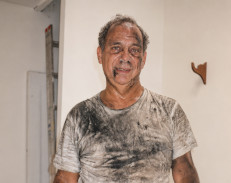 The alien from the attic
After we rebuilt the third floor with some local help, we decided to restore the rest of the house. We bought Jim’s share, engaged a wonderful architect, Margaret Salamone, set up a woodworking shop in our cellar, and hired some skilled craftsmen.
While changing the looks of the house, Linda created an exquisite 20-by-40-foot garden that reflected her extraordinary sense of design and the knowledge she gained growing up in a rural community. The first job was to clear the yard of trees.
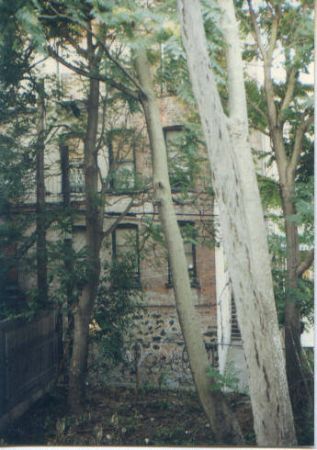 The trees in the backyard
at the beginning.
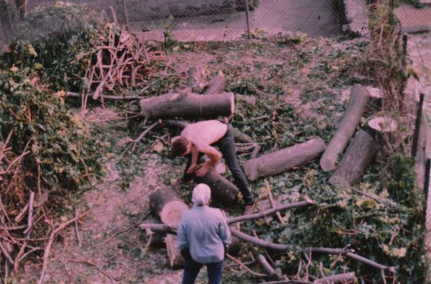
The trees in the backyard being removed.
Over time, another tree grew just outside our fence at the far end of our yard. We asked Linda's brother Larry to cut it down. He lived with us while he was a pharmacy student at Long Island University. When he started, some of the people who rented space in the building shown in the smaller photo watched Larry from their windows. They must have wondered whether he could actually get the tree to fall safely. But they needn't have worried; it fell perfectly, not touching any of the buildings or other backyard fences. When it landed, we could hear a round of applause.
Finally, after 19 years of living in what was essentially a construction site, the makeover was complete. We accepted the ongoing disruption of our lives because we believed in the outcome. Because of our shared vision, we were willing to live with the filth, relocate our bedroom and kitchen several times, and face many other challenges, including my hernias. We lived in that house for 32 years. To see the transformation of the Brooklyn brownstone and its backyard, click here.
Moving to East Taghkanic
Linda grew up in East Taghkanic, New York, an agricultural community in southern Columbia County, which we thought would be a good place to retire. She owned a share of the house, and we bought the other shares from her brothers. We planned to rehab and expand the old house and hired the same architect we used in Brooklyn. But rehabbing the house proved impractical, potentially costing more than building new, with a far less satisfactory outcome. We began the arduous process of working with the architect to plan a house that would meet our needs, obtain Town approvals, demolish the old house, and build a new one in its place. We were lucky to find an extraordinary general contractor, Don Hoysrad, to make it work. We mistakenly thought the proceeds from selling our house in Brooklyn would more than cover the cost of building a new house in Taghkanic, but we were wrong. We built at an unfortunate time, right through the COVID pandemic, when the supply chain was disrupted, labor costs skyrocketed, and in-migration from New York City drove construction costs up. The house cost us 25% more than we budgeted.
Linda knew every inch of our property, having meandered through it from childhood through adolescence. That sensitivity, love of place, and sense of design produced a wonderful landscape. To see the new house and the surrounding land, click here. In the photos, you will see the house up the hill, occupied by Linda's brother Larry, his wife Nicole, and his daughter Claire. Our house is therefore part of a family compound that has brought us much enjoyment. Linda has three brothers, and the four spouses, including Nicole and me, are collectively known as the "outlaws." Because we live so close, Nicole and I continually banter. Nicole likes buying me T-shirts, which I try to wear when we get together, but I always deny remembering she gave them to me. She always goes along with the shitik. Nicole, Larry, and Claire lived with us for a year because a garage fire made their house temporarily uninhabitable. Nicole and I saw each other almost every day, and I obviously didn't have enough of those T-shirts to keep that routine alive.
I have slowly become comfortable with country living, significant because I spent all my previous years in urban settings. I didn’t just move to the country; I let it work on me. But I worked on it as well. My contributions to beautifying the landscape have included mowing, weeding, weed-whacking, and digging. We built a 48-foot-wide, 4-foot-tall retaining wall in our garden with the rocks I extracted from the land.

The Retaining Wall
Being comfortable in the country didn't come immediately. The first time I drove our tractor, I went over a large tree stump, and the tractor ended up on top of it, swaying like a seesaw. I had to call Linda’s brother, Larry, to move it off the stump. That’s the day I rated myself 9% country, and only that high because I had bought some colorful T-shirts to replace my all-black New York City attire. But I kept working on my transition, and I'm about 98% there.

A Country Boy
What Now?
As I was writing this chapter, what came to mind was the old expression "Live and learn." I made plenty of mistakes with my parents, my first marriage, and my early relationship with my children. I regretted it all and changed my behavior in my second marriage and in my children's later lives. I came to understand what went wrong and grew progressively wiser.
What I have learned about my past is that I have made mistakes, and I will continue to make them. I believe all mistakes are lessons from which, with patience, humility, openness, acceptance, and effort, I can become the best I can be.
Chapter 2 - Creativity
I’ve spent much of my life in creative pursuits, mainly through writing, music, and crafts. My writing began with a career focus, later shifted to memoir and fiction, and also included playwriting. Music includes playing the violin as a child, then guitar, harmonica, ukulele, dulcimer, and drums. Crafts have included needlepoint and macrame. My proficiency has ranged from pretty good to atrocious, but I’ve always enjoyed it. In this chapter, I’ll describe those efforts.
Writing
I’ve been writing material for others to read, off and on, for about 60 years, often in collaboration with others. Professionally, I was the author, co-author, editor, or co-editor of seven books and seven articles on mental health, social services, and related subjects. Most of my recent writing has been literary, including fiction and memoirs in both poetry and prose.
In Chapter 1, I described how my mother’s difficulty recalling the details of her life prompted me to write memoirs. I began because I wanted my children to know who I was, especially since I struggled to communicate with them verbally when they were young.
I began by writing letters to them. They were largely chronological and certainly not interesting. I didn’t think I would want to read them if I were them, and assumed my children would grow tired of them quickly. As they increased in number, I imagined them saying, Oh no, not another one.
Soon after, I received a notice from The New York Open Center announcing a memoir-writing workshop. I attended it, liked it, and followed up with an extended workshop with the same teacher, Nancy Slonim Aronie. My letters to my children improved, and the vignettes I sent to them were soon turned into memoirs.
I then began taking workshops and private instruction in poetry with Rita Gabis, thinking I could express myself more emotionally in poems. I wrote many and kept writing memoirs. None of these writings focused on my children, and I thought some should. As mentioned in Chapter 1, we began sharing family stories at each of our birthday parties, a process we called the Legacy Project. My wife, Linda, came up with the idea, which I loved, and I decided to record the parties digitally. Through this process, I accumulated about 30 hours of family history, which added content to my growing list of memoirs.
With additional instruction from Emily Sachar, Rebecca Gee, and Therese Eben, and editorial support from Tom Fenton, I gained the confidence to self-publish. I independently published four books. One of them, Travel Light and Other Explorations, resulted from a collaboration with three other writers, Phyllis Carito, Al Stumph, and Phil Palladino. We explored our experiences of travel, both literally and figuratively, through poetry, essays, fiction, and memoirs. I had already published a book called Brief Memoirs, which contained 45 memoirs. The second book, The Fanciful and the Mostly True, included 20 additional memoirs, five of which I had contributed to Travel Light. It also contained 19 pieces of flash fiction, each a complete story of 1,000 words or less. The third book was called 23 More Memoirs, which brought my total of printed memoirs to 88, a birthday present to me, after passing my 88th birthday.
I consider my memoirs essentially true, though not entirely. A rendition of facts can be boring and usually needs embellishment, because a memoir needs to be a good story that grabs and holds the reader's interest. Also, memory fades, and gaps must be filled. When there are such gaps, I might ask relatives or friends if they recall the incident. If that doesn’t work, I make it up. What matters more than accuracy is the feeling that something essential about my life has been communicated coherently.
I changed course in my writing from time to time, from memoir and flash fiction to writing scripts. In 1990, I wrote a play called “Conversations on Death and Punishment,” which explored how people with potentially fatal illnesses often attribute the disease to divine intervention, characterized by the expression, “What did I do to deserve this?” The play was presented for several hundred people at an annual meeting of an agency where I worked.
Four years later, I was working at a settlement house on the Upper West Side of Manhattan. I was overseeing a program focused on people with AIDS and was struck by how exhausting it was for people who worked directly with people with that illness and how very difficult living with AIDS could be. I spoke with Joan Grossman, a filmmaking friend, about collaborating on short films on that subject, applied successfully for grants, and wrote the scripts. Joan produced and directed the films. The first was called “Both Ends Burning: Working with People with AIDS,” the second, “Rude Awakenings: Spiritual Support in the Time of AIDS.” Both films were shown at separate events and made available to agencies serving people with AIDS.
At times, my writing slowed, particularly during major life changes or health challenges. Yet even then, I sought opportunities to return to the craft, including attending workshops to reignite my creative flow. To see a complete list of my publications, click here.
Music
I played the violin as a young child, but I didn’t get back to playing until the hootenanny craze of the 1960s. I learned three chords on a guitar: D, G, and A, so I could play in the key of D. If anybody wanted to play in a different key, I had to use a capo, but that was fine with me. I later played the harmonica; its main attractions are its size, its ability to fit into virtually any pocket, and its intuitive playability. You can play a beautiful chord simply by inhaling or exhaling. I first became attracted to the harmonica during the two years I spent earning a master’s degree at NYU in Greenwich Village, New York City. There, I saw Bob Dylan playing the guitar with a harmonica rack attached to his neck. At the same time, I loved the harmonica sound on blues records and some popular songs, including the Beatles’ “Love Me Do.”
After I earned my master’s degree, built a career, and started a family, I put my creative endeavors on hold until January 13, 1975. On that day, I was politically terminated from my position as Deputy Director of Public Welfare for the State of Ohio when the governorship changed hands. I not only lost my job, but I also lost my identity. When people asked, “What do you do?” I had no answer. I needed to do something and decided to try crafts, first needlepoint and then macrame. I told people I was a fiber artist.
Crafts
My first endeavor was a rather elaborate needlepoint tapestry, a family tree of sorts, which became a wall hanging.

The Needlepoint
At the top right was the word “Chai” in Hebrew letters, which means “life. To its left was the letter A for Aronowitz, and below that were representations of Inuit and African artifacts that symbolized fertility, each of which we owned because our adopted son Jeffery’s mother was Aleut Indian and his father was African American. The pedestal bore the names of family members.
Needlepoint didn't last long because I struggled with fine motor coordination. I turned to a much less detailed craft, macramé. My first project was a long quadruple plant hanger. We placed it within the stairway of our house.

The Plant Hanger
I made many more macramé pieces, but my most ambitious was made in 1981. It was a huge macramé sculpture I made for an employee art show.

The Macramé Sculpture
The piece was 96 inches wide and very complex. When the show ended, I didn't have enough wall space at home to hang it. However, I worked closely with Four Winds Hospital, a psychiatric facility in Northern Westchester County, New York, and asked them if they would like it. They did, and we hung it in one of its beautiful rooms.
That led to two of my all-time favorite recollections. The first occurred at a gathering, where I was talking with a well-known local artist. I told her about my interest in macramé, and she began to talk about the “magnificent piece" she had just seen. As she described it, I asked whether she had seen it at Four Winds, and she said she had. I was ecstatic. She obviously didn’t know it was mine, so I knew she wasn’t just being kind.
The second recollection occurred one night when I was with a friend. We went over to Four Winds so I could show her the hanging. They moved it because they needed to paint the room where it had originally hung. During the move, some of the cords became twisted. The piece was designed to be symmetrical, but the twisting made one side noticeably askew. I tried to adjust the affected cords, but was unsuccessful. I thought it would be a good idea to cut about an inch off the bottoms of the offending cords so the problem wouldn’t be as noticeable. I asked a psychiatric nurse who was walking by if she had a pair of scissors.
"What do you want with a pair of scissors?" she asked.
"I want to cut this hanging. It’s a little askew."
"Oh, I see," she said, one eyebrow lifting noticeably.
Oh, it's OK,” I said. "I made this hanging. "
She looked at me, tilting her head a bit, and said, "Sure!"
"No, really," I responded. "I’m the Commissioner of Mental Health, and I gave this to the hospital.
"Right," she exclaimed, putting her left hand on her hip.
She began to walk away, and judging from the drift of the conversation, I imagined she went to tell some gargantuan psychiatric aides to get me back to my room. So I left. The piece is probably still askew.
The Happy Hour
Even though I was no longer interested in being a fiber artist, my interest in creative expression did not wane for long. Five years later, in 1986, Linda was the Director of Activities at St. Cabrini Nursing Home in Dobbs Ferry, New York. One of her programs was a once-a-week sing-along she called Happy Hour. She hired Dominic Chianese to lead the event. I was pursuing Linda at the time and sought opportunities to be with her. One evening, when I attended Happy Hour, I told Dominic I played the harmonica and asked if I could play along. He said I could. I did this every chance I could, and it went reasonably well. After a couple of times, he let me play some solos

At Happy Hour. Dominic is holding the guitar. I'm the one with the hat.
Dominic also occasionally played in taverns to supplement his income while working sporadically in theater and film. Once, he asked me to accompany him on one of his tavern gigs. I did, and I was hooked.

With Dominic Chianese at one of his gigs
Then Dominic’s acting career took off. He soon became famous as Uncle Junior on the HBO hit series "The Sopranos." He also began playing music with a small group of backup singers at nightclubs. Once, Linda and I attended one. Afterward, we went up to say hello. As soon as he saw me, he said, “Gene, what I need is a good harmonica player.” I didn’t know if he was serious, but in that moment, I decided it was time to get serious about my harmonica playing. I contacted an excellent teacher, Marcus Milius, who had a college degree in jazz studies and specialized in harmonica. I studied with him for almost 10 years, stopping only because, in 2018, Linda and I moved away from New York City to East Taghkanic in upstate New York.
Music and Memories
Up there, I began to play at an excellent nursing home. That facility was home to many residents, including Linda’s mother, who stayed there until she died. Once a month, from October 2018 to March 2020, when COVID prevented us from entering the building, Linda and I provided a program we called “Music and Memories.”
For about half an hour, as residents were brought into the program room in their wheelchairs, I played familiar folk, campfire, and spiritual songs on my harmonica. Once everyone was assembled, we played recordings of four or five popular 1940s songs that most residents could remember.
Before each recording, Linda talked about the meaning of the song’s lyrics. We did this, of course, to help the residents recall significant events from their lives before they needed that kind of care. If time allowed, we would do some sing-alongs, which I accompanied on my baritone ukulele. Then we would end the session playing a rousing Louis Armstrong recording of “When You’re Smiling,” hoping that when they returned to their rooms, they would do so with smiles on their faces. The song’s lyrics suggest that if people smile and laugh, those around them will too, because these expressions can be contagious.
We hoped that our efforts would bring pleasure and joy to the residents' lives. Furthermore, we expected those emotions to extend well beyond the session, so they might even view their stay at the nursing home more positively. Most people think that being in a nursing home is undesirable, and caretaking children often feel guilty if they have arranged for their parents to be placed in a facility. Yet, a good nursing home can be just what is needed to manage a deteriorating condition.
Linda and I tried month after month to convey to the residents that they could choose how they perceived their time in the nursing home. Although it wasn't how they initially wanted their lives to turn out, we thought we could help them understand that, all things considered, it wasn't too bad and likely was better than it might have been.
That reminded me of a time when I was coaching a children’s baseball team. One boy wanted to be a catcher, and I agreed. But because he sometimes closed his eyes as the ball approached, he occasionally missed it, enabling stolen bases or even runs to score. Some of the more competitive parents urged me to take him out. I asked him if he wanted to stick with it. He said he did because he had spent his allowance on the catcher’s mitt and thought he would get better at it. He liked being a catcher, no matter how bad he was.
I’m like that kid. I consider myself a pretty good writer and macramé artist, a respectable needlepointer and harmonica player, a mediocre guitar, Djembe drum, and ukulele player, and an atrocious dulcimer player. But mastery isn't the issue. Being creative means staying in the game, being willing to miss the ball, and, if you do, keep trying.
Chapter 3 - Spirituality
A major focus these days is spirituality, a quest more than 40 years in the making. It became especially important in 2023, when I was 86. I’m not sure why it took so long. That year, I watched many videos about life in monasteries and imagined our lives could be like those of the monks and nuns depicted in them. It seemed to me that our house on its five beautiful, peaceful acres in East Taghkanic, New York, could become a retreat center, and it did on several occasions. I thought that focusing on prayer and spiritual study would help me lead a meaningful life, one of holy significance, in which the sacred didn't have to compete for attention.
Living in a pseudo-monastery is not as weird as it sounds. A monastic life focuses primarily on prayer, meditation, study, exercise, creative activities, mindful eating, recreation, and work. Work needs a little explaining, since I'm retired and don't need to work for a living. My work begins early every morning. It may sound a bit strange, but I consider making our bed part of my work experience. I once listened to an audio recording of a 2014 commencement speech by Admiral William McRaven, a Navy SEAL commander. He said that making a bed properly accomplishes the first task of the day and encourages us to accomplish additional tasks. My other early-morning work commitment is to make a pot of coffee to drink when Linda and I have what we call CC&COTB. That initialism stands for coffee, conversation, and contemplation on the bed. Other work includes tracking our finances, working with Linda to beautify our landscape and grow some of our food, and assorted other household tasks including meal and beverage preparation. I frequently make alcoholic drinks in quantity, including Bloody Marys, Old Fashioneds, Manhattans, and Jalapeño Margaritas.
Every morning when I wake up, I review my intentions for my own thinking and behavior during the day. Then we go into CC&COTB, which usually lasts about two hours. After we talk for a while, we both meditate. Linda does Centering Prayer meditations, and I do what is called a Name of God meditation. Linda then prays the Rosary, and I do prayers using Mala Beads. Later, while I am exercising, Linda seeks guidance and insight from the I Ching.
Linda's primary religious focus has been involvement with an Episcopal Church, at first at the one in Hudson where she was baptized and confirmed. She initially considered Episcopal worship because of the writings and practices of an Episcopal Vicar, Cynthia Bourgeault, a modern-day mystic and proponent of Centering Prayer. Linda has now focused her attention on the church in Woodstock, New York, whose Vicar is closely associated with Cynthia Bourgeault and brings a contemplative orientation to that church. While in Woodstock, Linda and I occasionally participated in its Drum Circle, during which people gather weekly to drum, dance, and have fun. Feeling inspired, I bought a Djembe drum, and while practicing, I realized that playing the rhythm effortlessly felt like a contemplative practice.
Linda and I do not pray in identical ways, but over time, I have come to see companionship itself as a spiritual discipline—one that requires patience, humility, and the willingness not to judge. Almost every night, we watch and listen to lectures and documentaries relating to a variety of religious and spiritual traditions. I have learned a great deal from those teachers, but hearing how much they know has made it clear that I have much more to learn.
What I study and practice most is a psychologically oriented spirituality known as A Course in Miracles.
The Course
In 1965, Helen Schucman, a psychologist in New York City, began communicating internally with an entity she believed was Jesus after a series of inner visions and other psychic experiences. She was never in a trance and could stop and start communicating at will. This was the beginning of seven years of “scribing” the Course. Helen wrote the narration in shorthand and later dictated it to her colleague, Bill Thetford, who typed it. After seven years of scribing, this amazing set of teachings was published.
My initiation into that practice occurred one night in 1972, four years before The Course came into being and 12 years before I learned about it. That night, I got stoned on high-quality marijuana. It isn’t so unusual for people who are high to have difficulty remembering their thoughts, so I wasn’t bothered when I kept forgetting what I was thinking. My thoughts were like water on a paddlewheel boat: evident for a moment, then gone. Later that night, as I became more lucid, I thought about the thought-provoking experience I had gone through. I believed I had forgotten much, but I began to wonder if even that recollection was correct. I know this sounds convoluted, but I wondered if I had actually thought the thoughts I believed I had forgotten. I wondered if the whole night had been illusory. Then I wondered whether the day-to-day experiences I thought I remembered had actually occurred. I wondered if everything I experienced that night, and perhaps always, was an illusion.
Later that evening, and for the next few days, I read several philosophers' views on illusion, including the Greek pre-Socratic philosopher Gorgias and the eighteenth-century philosopher Bishop Berkeley. Both believed that nothing existed, and even if it did, nothing could be known about it. This was not entirely new to me. By then, I had already seen the film Rashomon several times, in which the various characters offered contradictory versions of the same incident. I was also familiar with Plato’s Allegory of the Cave, which asks us to consider if what we think is real is actually real. These days, I read the news and occasionally go on social media, but I no longer know what to believe.
I decided I could live with the possibility that everything I perceived, at least in its form, might be an illusion. I later learned that, even if it was illusory, I shouldn't disregard my experience, because there is much to learn from it.
In May 1984, twelve years later, a friend said she was going to a workshop on A Course in Miracles. I decided to tag along so we could spend the evening together. But I was skeptical. I assumed the Course was just another New Age fad that had dropped anchor in the 80s. Besides, I had pretty much given up on religion. I identified as a Jew, culturally, but was not interested in Judaism as a religion.
At the workshop, the leader said that, according to the Course, my body and the world were illusory. I tilted my head thoughtfully when I recalled the experience of getting high twelve years earlier and the subsequent days of exploration. I remembered accepting the unreality of my body and the physical world as a possibility, not entirely believable, but a possibility nonetheless. I listened more carefully to what I was hearing.
But then, I began to detach. The workshop leader said that the Course had been channeled and its source was Jesus. I could not imagine having anything to do with Jesus. Perceptions toward Jesus vary considerably and may include love, admiration, fascination, fear, disdain, or hatred. Initially, mine was fear. I remember being very uncomfortable as a Jewish kid in elementary school when we sang Christmas carols. Whenever the word Jesus or Christ came up in the song, I would lip the words, as if saying them out loud would transport my Jewish ass directly to hell. To allow Jesus into my life felt like a betrayal. The thought of telling anyone, even myself, that I was involved with Jesus seemed out of the question. Nevertheless, the content of the Course as presented in the workshop intrigued me, and I started paying attention again.
I heard that involvement in the Course would require me to become increasingly aware of my own thinking and what I perceived as my behavior, particularly while interacting with others. By doing so, I could change my mind if what I was thinking triggered reactions such as anger, fear, or other forms of distress. Being aware of my thinking and perceived behavior, to me, was called self-observation, a subject I had studied and researched as a doctoral student at the University of Chicago.
In retrospect, the connections between these seemingly disconnected events became evident, and I concluded that getting a Ph.D. with a focus on self-observation, getting high that night, and accepting the possibility that my body and the world might not be "real" had possibly been part of a calling, so I went for it. I signed up for a series of workshops with Ken Wapnick, who had worked closely with Helen Schucman, the scribe of the Course

With Ken Wapnick, my first Course teacher
It didn’t take long to make my peace with Jesus. The channeled material includes many first-person statements, and he clearly stated that he wants to be seen as an older brother rather than a savior. I saw Jesus as a model for becoming a better person. At first, I identified with what I learned about the historical Jesus, and soon focused on his way of thinking as demonstrated in the published Course material. It seemed to me that since he had been through his own transformative process, imitating him would help me get through it as well. His teachings were thought-provoking and eye-opening.
The Course involves mind training and thought reversal and has helped me reduce negative thoughts and emotions, such as anger, antagonism, contempt, and envy. With my expanding capacity for self-observation, I was able to capture my thoughts and feelings when interacting with friends and family, or when reading or listening to the news.
I mentioned at the beginning of this chapter that I was trying to adopt a pseudo-monastic life. Involvement with the Course includes the activities associated with monasticism -particularly prayer, meditation, and study - but it does not isolate itself from the world. In fact, it does just the opposite. It uses the rough-and-tumble of our current or past relationships to help us understand what is and isn't working for us in our quest for enlightenment. Through our relationships, we learn what aspects of our thinking and behavior need to change.
I think a great deal about what is not working for me from a Course perspective. Sometimes observing events in nature can set me off. For example, during the bird migration season, a flock of about a thousand grackles, or a mix of grackles and other blackbirds, gathers around our house for a few days. Grackles assemble in communal roosts before migration, some containing as many as a million birds. We have six windows in our bedroom, and watching and listening to those birds can be stirring and breathtaking.
Periodically, we can watch the whole flock swarm past our bedroom windows in a synchronized oval-shaped formation, first going in one direction and then, abruptly, in another. They fly like a single life form rather than a thousand. Each bird has become one with the flock.
They might suddenly drift into an open field as if guided by a decree. Or they might collectively elevate into nearby trees, creating a whoosh of air and a viscerally uplifting draft. The grackles seem to whistle and make rusty gate-squeaks, as if sharing their delight with one another. Then they fall silent, as if meditating.
If we are lucky, they pull together and swarm again. We watch them not only with attention, delight, and admiration, but we also wonder why these birds behave so much more collaboratively than we do. I am not saying that I never collaborate or that there are never examples of close collaboration among people I know or know about. But I know that I personally have had, and still have, much to change in that respect.
I was initially distressed to discover that my thinking was quite the opposite of the values that Jesus exhibited in his life and in the Course, including love, compassion, mercy, and humility. Many of my thoughts about other people were negative, particularly toward those I worked with who disregarded my requests or disagreed with me. I seemed to take pleasure in natural disasters in countries with which the United States was in physical or ideological conflict, and in states where most of the people fell on the other side of the political spectrum. Those with whom I interacted were usually unaware of that side of me since I was much too socialized, repressed, or deceptive to express those ideas openly. Nevertheless, I was not happy with the way I perceived others. I learned in the Course that my judgments about people are invariably wrong because I cannot understand what they’re really like from bits of perception, which are all I can experience. According to the Course, “In order to judge anything rightly, one would have to be fully aware of an inconceivably wide range of things; past, present, and to come.” I realized not that I should not judge, but that I am not able to judge.
I often ruminate about my unfulfilled expectations. My biggest one is to successfully emulate what Jesus did. As the channeled source of A Course in Miracles, he has become a primary role model. I study his teachings, try to apply them, and try to adopt both his behavior, as I understand it, and his manner of thinking as models for my own behavior and thinking. A striking example of his capabilities was his behavior during his crucifixion. I believe he reacted peacefully, without anger or condemnation, and that became a model for how I can respond without anger or condemnation in far less provocative situations in my life. I find it challenging to live up to Jesus’ example. I don’t think that lowering my expectations is the answer. Rather, I want to spend the rest of my life emulating Jesus, even though I constantly miss the mark.
These problems notwithstanding, I believe I am progressively becoming a much better person. Over the years, I have continued to study and practice the Course, and I still do. Over time, I changed teachers, first from Ken Wapnick to Jon Mondy, a prolific author and speaker. More recently, I shifted to Robert Perry, a respected Course teacher and scholar since 1986, who teaches along with his wife, Emily Perry, the Executive Director of the Circle of Atonement. Each of my teachers has approached the Course from somewhat different perspectives, but that hasn't been a problem for me. I have found that looking at this extraordinary guide to living in different ways is enriching rather than conflicting.
So I’ve been at this for over 30 years, and I am still learning. If the reader wants to learn more about the Course, several books by my successive teachers are good introductions: A Talk Given on A Course in Miracles by Ken Wapnick; Living A Course in Miracles by Jon Mundy; and Return to the Heart of God by Robert Perry.
The Course works for me, and I’m going to stick with it, but I have much to learn and understand, which is why I was so touched by a statement I read by the late Thomas Merton, a Trappist Monk and prolific author: "We do not want to be beginners. But let us be convinced of the fact that we will never be anything else but beginners, all our life!" Of course, I am a beginner not only in becoming spiritual, but in almost every aspect of my life- a sobering thought, since I am now almost 90 years old. I think it’s about time to try to get it together.
Chapter 4 - Education
Very early in my life, my education felt shameful. Back then, I didn’t have a correct word for it, but I knew what shame felt like. My body knew it even if my mind didn’t.
My academic performance in Junior High School was not wonderful, but it was acceptable. However, once I got into high school, the report cards I brought home were dreadful. My parents never condemned me verbally, but, as I recall, my mother would always get a little sad and look away. In our community, growing up Jewish meant facing high expectations for academic achievement. Most of my friends were also Jewish, and I imagined they were all destined to do well in school and to have successful, well-regarded careers.
The Guidance Counselor
An experience in 1954 deeply affected both my mother and me. On that day, all eleventh-graders in my high school were scheduled to meet with our guidance counselor. Students and parents inched toward her office in a snake-like procession, past the reek of gym body odor and the formaldehyde fumes of the biology lab. I was upset and worried about what she would say because I was near the bottom of my class. Perhaps that’s why the smells got to me that afternoon. Right behind my mother and me were my mother’s friend and her brainy, dark-haired daughter, who got all A’s and knew what she wanted to do with her life. With her hand on her daughter’s shoulder, my mother’s friend looked at us and said, “My daughter will have her pick of the best colleges, just like her brothers.” My mother nodded but did not look at me. That looking away always felt louder than anything she might have said.
When we finally got to the head of the line, we saw my guidance counselor, sitting at her desk, arms extended, fingers intertwined. She looked blankly out of the window, joining me, I imagined, in my desire to be somewhere else, and said, probably for the fiftieth time that day, “What are your plans?” I hesitated, then said, “I... uh... want to be a journalist.” She turned sharply toward me and exclaimed, “That’s a bad idea, Gene,” punctuating it with taps of the eraser end of her yellow pencil on top of my grades. “Perhaps something more practical would be better – something more practical.”
My mother’s lower lip and jaw jutted uncharacteristically, and her hands clenched. She looked straight ahead, not at me, not at her friend, who stood in the doorway with her daughter, and not at the guidance counselor.
I shook my aching head and whispered, “You asshole,” or, perhaps, those are the words I now put into the mouth of the kid I was back then, a seething underachiever, feeling sick, sad, and stupid. I was destined, it seemed, to be like my father, whose hands were soiled and whose shirt collar was stained after every day of work. At that time in my life, I didn’t think much of the work he did, although he and my mother had no problem with it. I thought it reflected his meager education, as he had only reached third grade. I wanted to be better than that. I wanted to be professional.
Continuing Academic Distress
I don’t think anyone in that school thought I would amount to much, and neither did I. I graduated from high school in the bottom fifth of my class. Educators seemed to think that such numbers were objective and accurate reflections of a student's worth, and at the time, I agreed that the number reflected who I was—someone at the bottom.
In addition to participating in many intramural sports in high school, I played on the school’s football team.

Out front scoring a touchdown
My friends identified me, and I also identified myself as a “jock.” My athletic activities during that time weren't limited to school. At the Wilmington Jewish Community Center (then called the YM-YWHA), I placed first in the decathlon for boys ages 15 to 18 and received the Arthur M. Blatman Memorial Award as the “outstanding athlete who best exemplifies the spirit of good sportsmanship.”
As is often the case with jocks, I did not do well academically. However, this was not related to preoccupation with sports or diminished intellect. Rather, as I later learned, it was related to having a vision impairment that prevented me from reading effectively.
I had trouble getting into college. The University of Delaware, my state school, indicated that I could be admitted, but only on probation. I went to another, apparently less selective, school for my freshman year, but I didn't like either the school or the distance I had to travel, so I transferred to the University of Delaware on probation for my sophomore year.
I tried to succeed and initially hoped to earn grades good enough to get into medical school. I was a member of the University of Delaware’s Jewish fraternity, Alpha Epsilon Pi, which consistently ranked highest academically among all fraternities on campus. I felt like an irresponsible member of this group.
It got so bad in the first semester of my junior year in college that I nearly flunked out. I remember sitting at home, waiting for my grades to arrive. I was terrified, accurately expecting the worst. My report card showed two Cs, a D, and two Fs. Sadness swept over me. Seeking distraction on that dreadful day. I went outside and got into my 1949 black Mercury with white walls, which I wanted my parents to buy because it was the car Jim Stark, the perpetually upset teenage character in Rebel Without a Cause, owned. I drove through the streets of Wilmington, past old friends’ homes, and over to Warner Junior High, where I had last done reasonably well.
I was actually a scholastic star on a single day at Warner, but an illegitimate one. When I was growing up, my parents would rent rooms in our house. The tenants, whom we called roomers, were like family members. My favorite was an army officer, Colonel McCauley, who lived with us when I was in eighth grade.
The Korean War was underway, and President Truman, whom I liked even then, had just fired General MacArthur for insubordination. Truman wanted to limit the war and keep it from becoming a global conflict. MacArthur publicly opposed Truman’s position. The President also wanted the military brass to clear public statements with the White House, but MacArthur would not comply.
I was working on an essay for school in which I intended to defend Truman. While sitting at the dining room table, Colonel McCauley walked by and offered to help me. As it turned out, he wrote the entire essay himself. No big deal, I thought. Lots of kids get that kind of help with their homework. I knew that it wouldn’t help me, but it got the job done.
I took my essay to school and, along with others in the class, I read it aloud. I don’t remember my classmates' reactions, but my teacher loved it. She really loved it. She arranged for me to read it to another class, and the other teacher loved it too.
They marched the entire school down to the auditorium to listen to my plagiarized essay. The place was packed, and I was relishing this undeserved admiration. I read the defense of Truman for the third time that day. The kids probably didn’t like any of it. Here I was, getting all this attention for something they didn't value. Besides, the essay was undoubtedly over their heads as it was over mine. Perhaps a few of them might have appreciated that I put one over on the teachers, but they were unaware of the subterfuge.
I probably understood that if I had been found out, I would have been in deep trouble. It would not have been pleasant if this ruse had been discovered. But it wasn’t. At the time, the whole episode seemed thrilling, and I don't recall any guilt, but I have no doubt Harry Truman would not have approved.
Anyway, while I was parking by Warner Junior High, I saw a red-tailed hawk soaring slowly in circles across the street over Brandywine Park. I walked into the park, found a bench, and watched a little black worker ant trying to cart a tiny twig toward his hill, only to drop it, pick it up, advance, drop it again, and repeat the process. When he finally reached his hill, still clutching the twig, I heard a high-pitched screech, looked up, and saw a hawk suddenly speed silently toward a squirrel scurrying up a tree trunk, much too slowly. I thought to myself, comparing the hawk and ant to my own struggles, Boy, they don’t fuck around. They know what they want, and they know how to get it.
I decided I had to do something dramatic. In the 1950s, young men in the United States were required to register for the military draft, but the law allowed student deferments, letting us finish college before being drafted. If I flunked out, I thought, I would get drafted and spend at least two years in foxholes. Enlisting in the military reserves seemed a better option than being drafted. It required only six months of active duty, assuming we weren't involved in an armed conflict. It was a rational decision to choose voluntary hardship rather than have something more onerous imposed on me. If my timing was perfect, I could serve six months and get back to school before the following fall semester. It turned out that my best option to accomplish that goal was to join the Marines.
In February 1958, at age 20, I was sent a train ticket to Parris Island (PI) in South Carolina. Two others from Wilmington, Delaware, my hometown, were on the same train. I could see that they were both excited, picturing themselves like John Wayne in the popular film “The Sands of Iwo Jima.” However, I found the trip stressful because I knew that about two years before, in April 1956, a recruit platoon at PI had been marched to a swampy creek at night. Most walked along the creek bed, but some drifted into deep water, fully clothed and wearing heavy boots. Six men drowned.
When the train arrived in South Carolina, a Marine Corps bus was waiting for us. When we arrived at PI, a drill instructor (DI) jumped onto the bus and started shouting insults and demands. We were herded into a large room where more screaming DIs were waiting for us. I had never been so confused and terrified. Their unnerving behavior lasted from that moment until the last few days of our 13-week stay on the Island, during which I received instruction in Marine Corps history, customs, core values, and essential skills.
For me, the worst day was when we had to demonstrate proficiency in shooting rifles. We spent a week in marksmanship training, and on qualification day, we tried to hit the targets accurately enough to score at least 180 points out of a possible 250. A score of 180 was passing, but just barely, like getting a D in school. The DIs had a lot riding on the outcome, having made bets with competing DIs, whose recruits all scored well. In our platoon, I was the only one who failed to qualify, getting a pitiful 179. From that day on, the DIs were hyper-critical of my performance and called me “Aronowfuckinwitz.”
That single missing point confirmed my continuing belief that failure in one endeavor, such as underachievement in school, could eclipse my many competencies. I was marked as a loser. However, I was well prepared for the physical challenges, including strength and agility tests, long hikes, runs, and water survival. One test was jumping into the deep end of a swimming pool in full uniform, including boots and a helmet, and getting out safely. I had no problem with that challenge because of my background as a lifeguard and swimming instructor. My skill in these areas took some of the heat off.
After graduating from that thirteen-week life-altering experience at PI, I spent the remainder of my six months of active duty undergoing infantry training at Camp Lejeune in North Carolina. After that, I served for an additional five and a half years, one weekend per month and two weeks every summer. I felt fortunate that I was never activated and, therefore, never saw combat.

In the Marines
After finishing my active duty, I headed back to college. Unfortunately, I didn’t do any better academically. I had already recognized that being a physician was out of the question because of my grades, particularly flunking organic chemistry and getting a D in physics. Letting go of that dream made academic failure feel even worse. I knew I had to figure out what to do with the rest of my life, first wondering whether I could become a dentist instead of a physician, and then, more realistically, a lab technician. However, even that would have required more science courses, which scared me. My lack of any acceptable future was a continual source of anxiety and sadness.
My Eyesight as Explanation
I thought obsessively about possible explanations for my dismal academic performance. In a eureka moment, I believed, for the first time, that the problem was not ignorance. I immediately went to the school’s reading lab for an evaluation. It showed that I read with one eye and then the other, losing my place during the switch. I read very slowly and had poor comprehension, and had the reading ability of a tenth grader. That knowledge gave me a strange but welcome sense of relief. I went to an ophthalmologist who indicated that I had a condition called exotropia, a misalignment of the eyes. I decided to have the operation he recommended, which he said would strengthen and focus my eyes. I didn’t know if it would solve my academic problems, but I thought it was worth a try.
The results, you should pardon the expression, were eye-opening. My double vision disappeared, and people told me I wasn’t squinting anymore. Nevertheless, after decades of bad reading habits, I still couldn’t read well. I went back to the reading lab and signed up for reading instruction. The results were dramatic. I didn’t read that much faster, but my comprehension increased to an appropriate level for a college senior.
Change of Course
I decided to switch my major to education, not because I wanted to become a teacher, but because I thought education courses would be easier, and I hoped to earn decent enough grades to graduate. I wasn't aiming for fulfillment, but for survival. Changing my major and reading more effectively helped me earn better grades the following semester.
As an education major, I was required to complete student teaching, and in my senior year, I taught high school biology. I got along great with the students, and my teaching seemed to be going well until the day I was to present material on which I had failed an exam the previous semester. My familiar fear of appearing stupid took over, and as I began the lesson, I struggled to speak, periodically gasping for breath. Even though it was cold outside, I opened the window to let in some air, and, while it was easier to speak, I paused frequently to catch my breath. The students were patient with me and seemed sympathetic, but I was distressed and embarrassed. From that day forward until the end of student teaching, I was over-prepared for each class and kept the window open at least a crack. A good day in my classroom was when I could say what I needed to say without gasping.
It was clear to me that I didn’t want to be a teacher, not because I looked down on it, but because the thought of speaking all day in enclosed classrooms filled me with dread. I considered several alternatives to teaching, and one appeared unexpectedly. I had spent many summers working at the Jewish Community Center of Wilmington, Delaware, primarily as a camp counselor, a locker room attendant and a lifeguard. I saw a flyer on a bulletin board at the Center asking whether I liked that kind of work, which I did. It said that I could enjoy a career much like that by becoming a social group worker. It also said fellowships were available if I was willing to work at a Jewish Community Center for two years after earning a master’s degree. I liked the idea of spending my time in such a setting, and social group work as a career seemed appealing. I hoped to get into graduate school, but that seemed challenging because I just barely graduated, 334th out of 404 students in my class.
Social Work
I applied to six graduate schools of social work and was accepted by only one, which, at the time, was threatened with the loss of accreditation. Because reading was no longer an impediment, I received an A in 12 of my courses and a B in the other 8.
With my master’s degree, I began a good career, but not good enough by the standards I thought my friends had achieved. Invitations to high school reunions were as welcome as jury notices. But things did begin to change. I got a job at Hull House in Chicago, and in 1966, my work as a group therapist for children there began to get noticed. My practice was based on significant research at Case Western Reserve University. Paul Gitlin, a graduate of its doctoral program, taught at the University of Chicago School of Social Service Administration. He knew the researchers and the study's content. He brought his students to observe my practice, and other faculty also became interested in my work. A paper I wrote about my practice was published in that school’s highly regarded journal, The Social Service Review. I was on a first-name basis with many faculty members, and the relationships were cordial.
I applied for admission to the doctoral program at the University of Chicago. Because of my low undergraduate grades, they asked me to take their statistics course to demonstrate my intellectual ability. I did very well in that course, and they admitted me.
When I entered the program in the fall of 1967, the first-name basis disappeared, and they referred to me as Mr. Aronowitz, which I perceived as a distancing gesture. The widespread presumption of my competence also disappeared. Whereas they previously saw me as competent unless I demonstrated otherwise, they then considered me incompetent unless I passed their examinations or wrote excellent papers. I was offended by how I thought I was being treated, which led me into a series of activist activities that I will cover in Chapter 6.
Activism notwithstanding, I approached my doctoral education methodically. My dissertation was about self-observation capacity, a subject that really interested me, but I was committed to keeping work on my dissertation as short as possible. I figured out a way to collect data in a few weeks. I also scheduled appointments with my dissertation committee rather than waiting for them to read my drafts and get back to me. I got my dissertation approved and graduated in two years and nine months, close to a school record.

Graduation day with my mother and father
I graduated in 1970, 15 years after high school. I had already received three invitations to high school reunions, which occurred every five years. But for reasons that still elude me, I didn’t think my career measured up to what my friends had presumably accomplished. I also skipped the fourth reunion, but in 1978, 23 years after graduating from high school, I got myself a very high-profile job. That achievement, my Ph.D., and the effects of a very successful diet seemed to support my attending the next reunion, the 25th.
I was shocked when I arrived at that reunion. I expected everyone to be as I remembered them, and shook my head in disbelief when I saw the women in muted dresses that reached well below their knees, a sight that stood in stark contrast to my recollection of crinolines ballooning like parachutes in time with the rock-and-roll music popular when I was in high school. Around the dance floor were about 20 large round tables, each one commandeered by some reconstituted clique. I didn’t know where to sit and, recalling similar anxious moments in the high school cafeteria, my old jealousies and animosities erupted.
And then I saw her.
Instinctively, I stepped toward my old high school guidance counselor, the one who told me to forget about entering the professional world. I strutted across the dance floor to where she stood, exhaled deeply, extended my hand, and said, a bit disdainfully, “I’m Gene Aronowitz.” She took my hand, but her head tilted slightly, and her eyes narrowed. Then, she glanced at the high school yearbook picture on my name tag, raised her head slightly, either grinned or smirked – I’m not sure - increased the firmness of her handshake, and said, “Yes, Gene, how are you?”
Her hands were swollen, and her thinning hair was gray. Vertical crevices ran down her face and above her lips. I had imagined what I could say to her hundreds of times, preparing to produce the perfect punitive impression. But the words stuck in my mouth like peanut butter. I hesitated a moment more, nodded, and said, “I’m fine……… I’m fine.” That was it.
I asked how she was, but barely heard her response. I regretted not saying something to her about my achievements. As time passed, I hoped I would see her again at the 30th reunion and practiced telling her how wrong she had been.
In the five years between the 25th and 30th reunions, I had my 15 minutes of fame. I was the Commissioner of Mental Health in Westchester County, New York, and was frequently called on by the local and national media for comments on mental health issues both locally and nationwide. When I attended the next reunion, I was elated to see my former guidance counselor show up as well. She must have seen me on television, because she greeted me warmly, and I was shocked to hear her say, “Gene, I knew that all you needed was a little push.” In her mind, she took credit for my higher education and achievements. As she spoke, I realized her actions while I was in high school had done much to shape me emotionally. Nevertheless, as we spoke, something changed. I regretted all those torn-up high school reunion invitations, all that self-doubt, and all those years of feeling vindictive. My pointless anger evaporated. For that wonderful moment, I was no longer living inside that old wound. I was a changed person, feeling good.
Chapter 5 - Career
As a teenager, I spent most of my leisure time at the Jewish Community Center of Wilmington, Delaware. I worked there as well, taking care of the office at night, and during a few summers, I worked as a camp counselor, a locker room attendant, and a lifeguard, activities that turned out to be significant in later occupational choices.
One summer, while I was in college, I worked as a swimming instructor at a residential camp for children in the Pocono Mountains of Pennsylvania. I will never forget the looks on my young swimming students' faces as their fear evaporated and cool water enveloped their bodies. Each child's camp season lasted 7 weeks, and almost all of them mastered the skills needed to move out of my beginners’ class and into more advanced instruction. For me, the gratification came from watching the campers master each task, shifting from confusion, doubt, and disappointment to surprise and delight. Particularly pleasurable was the look of triumph when each former non-swimmer jumped into the water and swam to the other side. Why did they swim to the other side? Because they could. Their triumph felt personal.
The Anxiety Attack
In Chapter 4, I described my difficulty in breathing when student teaching. As a result, I did not become a teacher, fearful of speaking in enclosed classrooms. Instead, I pursued a career in social work. However, that didn’t mean I had no problems with public speaking. While working as a social worker at a Jewish Community Center in Louisville, Kentucky, I wrote a paper about one of the programs I created. I was asked to read it at a meeting of the local chapter of the National Association of Social Workers (NASW).
The day before the presentation, I asked my supervisor to listen to the paper and provide feedback. He agreed. I began to read and immediately found it difficult to catch my breath, just as I had experienced when student teaching. I stopped reading, fearing that continued failure in front of just this one person would poison the real event. I left work early, went home, and hardly slept that night, knowing that some important people were expected to attend the meeting, including, I was told, the Dean of the University of Louisville Graduate School of Social Work. At twenty-five years old and a neophyte in social work, I considered this the equivalent of a Broadway audition.
The next morning, I felt dread as I waded through the increasingly disastrous scenarios flooding my mind. I was tense and so terrified I could hardly eat. I knew that I often ate to reduce anxiety, so not being able to eat made matters considerably worse.
At the meeting, the organization's president introduced me. I stood up, stepped to the podium, opened my binder, thanked the president, looked down, and saw the page was wet where my fingers touched it. As I focused on my sweaty hands, I noticed a slight tremor in the pointing finger, and it was difficult to keep it on the correct line.
When I began to read, my throat and chest tightened. I opened my mouth as wide as I could and expanded my chest, but felt nothing coming in. Preoccupied with breathing, I couldn’t remember what I had just read. I stood there, terrified and ashamed.
The president, sitting beside me, offered me a glass of water, but my hand was shaking so much that I was afraid to bring it to my lips. He offered me a lozenge, unwrapping it before handing it to me. I nodded, slipped it into my mouth, sucked on it, waited to calm down, and waited, and waited, and waited.
While I stood there, I wondered if I could get through my presentation. If not, I wondered whether I should just sit down or maybe leave the building. I wondered if this would happen again whenever I needed to speak in public. Because almost no one in the audience was making eye contact with me, I wondered what they were thinking and what they would say to colleagues who hadn't come to my presentation. I can’t remember anything past that set of wonderings. I remember only the panic. I always remember the panic.
I have given presentations to large groups since then, and because I remain slightly fearful, I always pop a lozenge or two in my mouth to keep it moist. Fortunately, that horrendous experience has never repeated itself. I discovered that, for me, courage is not the absence of fear but the willingness to keep showing up despite it.
Hull House
After Louisville, I got a job at Hull House, one of the most famous settlement houses in the United States. In 1964, my first year, I provided treatment services to members of families with multiple environmental, economic, and psychological problems. Part of that work involved group treatment for children who were resistant to treatment. As described in Chapter 4, the University of Chicago faculty learned of that work, which helped me get accepted into a doctoral program at the University of Chicago.
Within a year, I was promoted to Director of Social Work Services, responsible for all social work practice and programs within this seven-agency settlement house association. We provided social work field instruction for 32 students from 3 graduate schools of social work.
In early 1970, during my last year in the doctoral program, I received a letter from Boston Children’s Service Association asking whether I would be interested in being considered for its Associate Director position. I don’t know how they knew about me, but the opportunity sounded attractive. I learned what I could about the agency and then met with Chuck Bates, the Executive Director. I thought the interview went well.
Chuck wrote that my credentials and knowledge were perfect, but I came off so low-key that he didn’t think I had the power or energy to handle the job. He suggested a second interview. I said I would return, but I knew I wouldn't act differently. That’s just the way I was; I spoke softly and slowly. However, I pointed out that this did not mean I lacked power; many in Chicago considered me a radical. Chuck checked with some of his Chicago contacts and learned that I had led demonstrations and participated in other forms of social action. He decided a second interview wasn't necessary and made an offer. After I graduated, my growing family left Chicago for Belmont, Massachusetts, a Boston suburb, and I started my new job at Boston Children's Service Association.
Chuck and I worked very well together for about two and a half very positive years. I was responsible for the services the agency provided, continued to provide group treatment, and participated in an effective advocacy organization, The Task Force on Children Out of School.
During that time, Chuck’s close friend, Jack Hanson, served as Chief of Staff to Ohio Governor John Gilligan. He offered Chuck the position of Director of Public Welfare. Chuck accepted and asked me to join him as Deputy Director. I accepted, and we moved to Ohio.
Deputy Director of Public Welfare
I stayed busy in our office building, tracking federal laws and regulations and ensuring internal and external communication flowed smoothly. I liked the work, but never got used to being so invisible. I held a Deputy Director-level position, but everything I produced bore Chuck’s name, not mine. I told myself that was the price of being close to power, but the cost was higher than I expected. Recognition mattered to me, and not being recognized the way I wanted to be became irritating.
Governor Gilligan had been preceded by James Rhodes, who served two four-year terms and could not run again at that time. Before leaving office, Rhodes placed his top staff in lower-level positions, offering them job security while keeping them on board if he ran again, which he did, and when he defeated Governor Gilligan, his former team emerged, as if by spontaneous generation, to resume their previous jobs. At noon on inaugural day in 1975, Jack, Chuck, and I were all out of work. It was a clean sweep; three levels of the bureaucracy were gone.
Chuck and I both heard that Westchester County, New York, was seeking a social services commissioner, and we each applied independently. Of course, I had no chance against him. Chuck headed a state agency, and I was actually his assistant. At the end of February, 1975, Chuck was appointed Commissioner of Social Services in Westchester County for a five-year term.
The Department of Social Services was in bad shape, with the County Police and District Attorney investigating possible welfare fraud and mismanagement. Chuck wasted no time implementing a major shakeup and asked if I was interested in becoming Deputy Commissioner. I had been looking unsuccessfully for a job and eagerly accepted. I started in May 1975.
Deputy Commissioner of Social Services
I oversaw all services within the Department of Social Services. This included managing quality control, ensuring employees did their jobs competently, and verifying that people receiving our services were eligible for those benefits. We uncovered an issue involving a group of Chasidic Jews who operated a school and, from what we understood, officially paid their teachers a pittance, but provided additional money under the table. Because the teachers could claim little income, each qualified for Medicaid. From our perspective, the County appeared to be supplying the school with a free comprehensive health insurance plan.
I contacted the school's head and asked him to come to my office. When the Rabbi arrived, he tilted his head and asked my name, which he already knew from our correspondence. I pronounced my name, and he countered, “That’s a Jewish name, isn’t it?” I answered that it was. He responded, speaking with an upward inflection, “You’re Jewish?” I said I was, and then, in a very accusatory tone, he said: “Then how can you perpetrate this holocaust?” I glared at him, said nothing for about 15 seconds, and then responded, “Because it’s ashanda fur die goyim ” – a Yiddish expression used to suggest that this kind of activity by a Jew would be very embarrassing to the Jewish community if observed by a non-Jew. The Rabbi stopped the grilling and settled into the interview.
My encounter with the Rabbi clouded my perceptions. I believed the stereotype that they treat fellow Chasidim with honesty and respect, but treat those like me who are outside of their community with disdain. I also thought that whatever resources they could get from the outside world would be considered an end, justifying whatever means it took to achieve them. Fortunately, subsequent contacts with Chasidim reduced my stereotypic thinking and lessened my negative feelings.
Needing to Move On
During my third year at the Department of Social Services, I knew it was time to move on. The American Public Welfare Association had asked Chuck to write a paper on public social services at the local level. However, Chuck was not a writer; I was, and I had already published two articles in professional journals. I wrote the paper, but because Chuck was the Commissioner, his name appeared as the senior author. I understood why that happened but didn’t like it, which reminded me of my unrecognized role in Ohio. I thought my individuality was being suppressed by my coat-tailing, and thought it was time to get out from under. I learned that the county’s mental health operation had been reorganized, and a search was underway to recruit a commissioner to head the new Department of Community Mental Health.
I told Chuck I was interested in the opportunity, but he was not encouraging. For the past eight years, and I’m sure during our conversation, he considered me a second banana. Also, I had just turned 40, 10 years younger than him, and he probably considered me too young. I concluded that the Commissioner job might be my best, and perhaps last, chance to be the high-level, independent professional I wanted to be. I wanted that job.
I knew I had the qualifications, but I didn’t look the part. For years, I projected a laid-back, relatively informal image and rarely wore a tie. I knew that was working against me. One day, I saw a Doonesbury cartoon that changed my life. Here is that cartoon:
 DOONESBURY © 1978 G. B. Trudeau. Reprinted with permission of ANDREWS MCMEEL SYNDICATION. All rights reserved.
I understood that if I wanted to get the part, I had to look the part. I bought the very popular book "Dress for Success," devoured it in a day, followed its advice, and bought three very conservative three-piece suits in the correct colors, with all the proper accouterments. After dressing appropriately for a while, I asked for an appointment with Alfred DelBello, Westchester County Executive. During our two-minute meeting, he said he would certainly consider me for the job.
I was a little put off by how quickly he dismissed me, but DelBello had a lot on his mind. The United States Department of Labor had issued a report citing “major deficiencies” in the County’s $35 million federally funded CETA (Comprehensive Employment and Training Act) program. The program aimed to help unemployed or underemployed individuals by offering them jobs with public agencies or not-for-profit organizations, helping them develop marketable skills and, once that was accomplished, transition to unsubsidized employment.
Beyond the government's critical report, the District Attorney was investigating what he called “pervasive corruption” in the CETA program, including nepotism and misuse of funds. To make matters worse, a New York City television station assigned an investigative reporter to see what was happening. Unfortunately, the Director of the CETA program ignored him, which irritated the journalist and the station, and their frequent reports were blistering. The County Executive himself was vulnerable because the CETA Director was a longtime friend who had worked with him as he rose politically.
A few days after we met, the County Executive called me in and asked me to take over the CETA program and do whatever was necessary to get it under control. I saw his request as a potentially prolonged and perilous job interview. If I screwed up, I could forget about the promotion. However, if I stopped the scandal and improved the program, my prospects would be excellent. I wanted that job badly, accepted the challenge, and was appointed Acting Director of the CETA program, on partial leave from my Social Services position.
I recruited two County employees, human resources and data analysis specialists, to assist me in reorganizing the program. We established new, more efficient procedures and created overly stringent internal controls to assure the federal government and the media of our resolve. Many agency administrators objected to those controls, but I believed they were essential. I believed that satisfying the press was vital because scandals can escalate if not addressed quickly. I decided to grant the press unfettered access. Consequently, newspapers, radio, and television covered the program’s restoration continuously. A column in a local paper noted, “Friends used to call him Gene Anonymous, but Pleasantville resident Dr. Eugene Aronowitz has lately become a prominent figure in Westchester news.” An article about the search for the Commissioner of Community Mental Health position stated, “One name recently mentioned is that of Eugene Aronowitz, a deputy social service commissioner...” Two weeks later, a column describing my work with CETA read, “Dr. Aronowitz’s name has now come up in a new context, as a candidate to head up the new Department of Community Mental Health under the County Executive."
A month later, I was appointed.
Commissioner of Community Mental Health
As Commissioner, I was responsible for services in Westchester County for people with mental illness, those with developmental disabilities, and those abusing drugs and alcohol. Shortly after my appointment, I organized an event to discuss where the department had been and where I expected it to go. During the gathering, I introduced many of those who had come before me.

Honoring my predecessors
I attended many large gatherings, which was essential, but these events were also one of the most difficult challenges I had to deal with. At those events, people often shouted to be heard, and the shouting of hundreds of people can be deafening, diminishing anyone's ability to hear others. That has always been a problem for me. I developed hearing problems while serving in the Marine Corps. I had difficulty hearing and didn’t get hearing aids until many years later. I also speak softly, and the din can obliterate my speech. I also talk slowly and somewhat thoughtfully, which often left me unable to connect with others. There is often a moment of silence as I consider what to say. That’s just enough time for people to tune out and for someone else to fill the gap. Small talk is not even close to being something I’m good at.
As a public official, I often had to sit on a dais at sit-down dinners, usually a long table on a raised platform. Organizers considered such seating an honor, but I saw it as a burden. Being unable to hear was not my only problem. Particularly egregious times were when I was placed at the end of one of those long tables, and the two people next to me spent all night talking to each other. I resented being so isolated and exposed. But even worse, when I wasn't at the end, I had to lean back when the person to my right and the person to my left wanted to talk to each other.
I always despised the idea of sitting on a dais, so I came up with what I thought would solve the problem. In 1984, I served not only as Commissioner but also as Chair of the Westchester County United Way fundraising campaign. I insisted that all United Way fundraising events use what became known as the Aronowitz Dais Design. It consisted of small round tables on an elevated platform. Even if I was not involved in any conversations, at least I didn’t look or feel ill at ease. I could nod at the speakers even if I couldn’t hear a word they were saying.
Thirty Minutes of Fame
A series of tragic events in Westchester County in February 1984 thrust me into the limelight. Five teenagers committed suicide within 30 days. As the county's senior mental health official, I had to respond to almost continuous press inquiries. Interest was intense, not only locally but nationwide. NBC Network News and the major New York City television stations interviewed me. The wire services, including the Associated Press (AP) and United Press International (UPI), spread the story. Newspaper articles featuring my comments appeared in Arizona, California, Colorado, Florida, Georgia, Illinois, Iowa, Kentucky, Louisiana, Massachusetts, Montana, New Jersey, Ohio, Pennsylvania, Vermont, Virginia, South Dakota, and Texas.
I enjoyed the celebrity and, at times, even exaggerated it. Once, I offered a colleague a ride when I drove up to Albany for a meeting. When my car approached the Tappan Zee Bridge, the toll taker reached for my money and said, “Oh, hi, Mr. Aronowitz.” I nodded and smiled. My passenger’s face revealed his astonishment as he remarked on how well-known I had become. I shrugged, giving him the impression that this happened all the time. I never let on that the toll taker was a teenager who lived in the cul-de-sac behind our house. Shameful, I know, but at the time, hilarious and exhilarating.
Nevertheless, delighting in my notoriety soon began to bother me. The attention felt good; the reason for it did not. The media attention resulted from alarm and compassion for those poor, dead kids and their grieving parents and friends. They are what made the story so compelling, not me. It was unsettling to acknowledge that my brief celebrity, my fifteen minutes of fame, blossomed because of such misfortune. That disturbed my understanding of my motives.
I also made many blunders during my years as Commissioner. For example, I screwed up while delivering a speech to my counterparts from other counties in New York State at a large professional mental health gathering. I was sharing an idea and expected a reasonable, if not benign, response, but I misread my colleagues and got a dramatic, antagonistic reaction instead.
New York State had been experiencing a crushing financial crisis, some of it due to increased costs and poor administrative practices within the state’s mental health system. I was asked to serve on the Governor’s Select Commission on the Future of the State-Local Mental Health System. The then-Governor, Mario M. Cuomo, called for “a total overhaul of the system,” including restructuring mental health services and improving financing mechanisms.
I was asked to report on Select Commission activities at the gathering. But in addition to describing some of the proposals being discussed in the Commission, I also decided to share details of a cost-saving idea I was considering. Since I was only asking for their opinions regarding my idea, I expected a civil discussion that would help me refine my thoughts. Their response was far from civil.
Here was the idea that I told them about: The County and State governments both planned for and oversaw county mental health services. I considered that a costly redundancy and wondered whether the State government should independently carry out the planning and oversight functions of those mental health operations, including my own. I thought that would save a lot of money.
After the meeting ended, the Chairman of the Conference of Local Mental Hygiene Directors, of which I was a member, demanded that I accompany him and almost fifty other members to a small room. I was irritated by the way I was being treated, and to make matters worse, the room was hot and windowless. We were not about to have the civil discussion I had anticipated. The Chairman was irate and hurled many invectives at me. About ten others joined in the barrage.
Those who spoke expressed resentment that one of their own was about to propose eliminating a major part of their job responsibilities. Some implied that I was a traitor, erroneously suggesting that I had been appointed to the Select Commission to represent them and, by implication, to express their views. I sat there silently, seething, but my anger soon dissipated as I rationalized that the negative comments were self-serving and not worth taking seriously.
One of the members came over to me after the meeting and said he agreed with me, although he wouldn't say so publicly. I imagined that many of my other silent colleagues felt the same. That was not the case. I later learned that many believed State employees would have limited knowledge of individual counties' needs and would invest too little in addressing them. They had a point.
I subsequently ran for Chair of the Conference of Local Mental Hygiene Directors and lost the election.
That was not my only interaction disaster. One December, I was invited to be the guest on a radio talk show about holiday blues. I said this was a time of year when everybody is supposed to be having a great time, but these expectations are rarely met, as holiday celebrations can often be troublesome. Old sibling rivalries and animosities can get in the way, as can political differences. I said that for many of those unconnected, New Year's Eve can be the loneliest night of the year, and everyone should be on guard for the warning signs of suicide, which I enumerated. After about 45 minutes of discussion, the host said the phone lines were open and asked whether anyone had questions or comments. She gave the phone number, after which there was dead silence. She repeated the number, and silence persisted. To fill the disconcerting space, she asked me how listeners could help if they knew of someone who might be contemplating suicide. The gist of my reply was that they should take them seriously, let them talk, never argue with them or say it's all going to be alright, and possibly help them access a hotline or a mental health clinic in their area. I brought along the county's directory of mental health services and expected someone might ask for details. But nobody did. The host repeated the telephone numbers, but still no one called in. She filled the rest of the hour talking about an unnamed friend who suffered silently for years before killing himself. That distressing story ended the program. When I returned to my office, Steve Friedman, the Deputy Commissioner, looked at me and said that if the audience wasn’t depressed before I got on, they surely were by the time I got off.
My next mistake could have been a disaster. I had to attend a seemingly endless number of annual meetings and fundraisers, almost all of which served food and many of which offered alcoholic beverages. At one event, I drank a little too much, and around ten or eleven o’clock that night, I was swerving slightly on my drive home. A New York State police officer pulled me over. He asked me if I had had a few drinks that evening. I was fully coherent and said that I had. Seeing that my car had official plates, he asked if I was a public official. I told him what my job was. He understood that I was responsible for services to those involved in alcohol abuse and asked if I could imagine the headline if I was caught driving drunk. I said, or maybe I whimpered, that I could. He replied, “OK. Get home safely.” I appreciated the courtesy and, as a result, was always more careful about drinking.
Another night, I walked into a large annual meeting. The room was already crowded, and I started looking around for the right person to talk to, which was difficult for me because the lights were dim and my eyesight had always been poor. In addition, I wasn't very tall. I tilted my head up as I tried to find my way around the room, and I was surprised when the lower part of one leg collided with a soft object, throwing me off balance. I heard a whiny bark, looked down, and saw a seeing-eye German Shepherd. As I careened, I instinctively reached out to stop my descent and grabbed the arm of the blind guy who was holding the loose leash. Shocked, he shouted a very audible “Shit!” His screech caused a cascade of head-turning. Then, there was silence, not a slowly diminishing fade-out kind of silence, but a sudden power failure kind. I shoved the dog aside with my leg, not thinking about how this could result in a painful puncture from the dog's sharp canine teeth. I pulled the blind guy toward me until we were both standing somewhat erect. My face was red, my heart was pounding, my head was throbbing, and my hands were cramping. I was humiliated. I leaned close to my victim’s ear and apologized. He said nothing, just tilted his head. His face was blank, possibly masking a carefully controlled rage. I started worrying about what people in the hall would say to each other during the event and to others in the days that followed. I apologized again and moved away, trying to figure out how to salvage the rest of that already disastrous evening. I thought my best bet was to make a self-deprecating joke about it, but I really didn’t feel like laughing.
Moving On
I had been Commissioner for almost 10 years, felt good about my successes, and handled my mistakes reasonably well. But my responsibilities and activities had become repetitive. I was a little turned off by being so public and newsworthy. Therefore, I was pleased when I received a call from the President of Westchester Jewish Community Services, a large, well-regarded agency. He asked me to meet with him, and when we did, he asked me to consider becoming that agency's Executive Director. He offered me a salary that was 60% higher than what I was earning, a very persuasive hook because I had mortgages on two houses, hefty child support, 2 kids in college, 1 about to enter, and another expected to go in 2 years. After a polite conversation, I told him I would get back to him, and a few days later I accepted the offer.
The Tower
The agency had some serious financial difficulties. I reorganized, tightened our spending, secured government grants, and started new programs that generated surpluses. In about a year and a half, the agency was solvent.
On a day off, Linda and I visited Woodstock, New York. Linda brought her Tarot deck and suggested it would be a good time and place for a reading. Dubiously, but in the spirit of Woodstock esotericism, I agreed.
We sat down under an ash tree along the bank of the Millstream. Linda placed a piece of silk cloth on a large rock, asked me to lay both hands on the deck, and think of a question. No specific issue came to mind, so I simply thought, "What is in store for me?" She asked me to cut the cards, then distributed 10 of them from the top of the deck in a specified pattern, each position determining the card's implication. The card in the position that signified what is likely to occur soon was The Tower.

We looked at each other. That card is particularly unwelcome, for it can connote caustic change, the collapse of current ways of life, crisis, conflict, and catastrophe. Getting that card in that position can be very upsetting, but serious problems seemed unlikely to me. Everything in my life seemed to be going along smoothly. My relationships with my wife, children, and friends were positive. I was pleased with how my work life was going. I had solved the problems I was hired to solve and felt secure.
But within weeks after the Tarot reading, upsetting problems began to emerge. The Westchester Jewish Community Services Board President who hired me had stepped down, and the new Board President told me she was concerned about my relationships with Board members. She said I wasn't communicating with them the way all three of my predecessors had. They saw me as distant and aloof.
I had been hired for my management skills, but once I had addressed the problems those skills were designed to solve, these other unexpected requirements emerged. Board members wanted a more sociable relationship. No matter how hard I tried, I couldn't meet their expectations for cordial and friendly relationships, and I became increasingly discouraged. Once, while brooding in a chair at home, Linda said I looked like I was sitting inside a walk-in refrigerator.
After several months of bleak progress, the Board President called me in again. The tension in her voice was unmistakable.
“Gene,” she said, “it’s not going well.”
“I know," I said. "I've tried. But what you want me to do is not in the cards. It’s just not me. Are you saying that it’s time I left?”
She said softly, “I guess it is.”
I strutted out of the room, but once I hit the sidewalk, my shoulders drooped, and my chest heaved. I gave up a great job for this, I thought. The job change to a higher-paying one had made sense, but although the financial obligations persisted, the job didn’t. It was over.
They gave me a reasonable severance package, and, anticipating its end, I began consulting. However, progress was slow, and after that initial infusion of money ran out, the challenge of meeting my immense obligations was terrifying. Missing payments or even being late was unacceptable because I had previously established an excellent credit rating and wanted to maintain it. I borrowed from a credit union to cover large expenses, often borrowed from a friend to repay the credit union, and sometimes, if necessary, borrowed from the credit union to repay my friend.
But one time, that didn't work. A mortgage payment was due in two days, but both loans were still outstanding. I had no idea where else to get the money. I was like a duck on a rotisserie as I tried to sleep that night. But then, seemingly miraculously, I received a call the next morning from a former employee who had since become an agency executive. He asked if I was free to help them on a project. I said I was and met him that afternoon. I was stunned when he asked if I would like to be paid in advance. I took it as a sign and asked Linda for a follow-up Tarot reading.
When she laid out the cards, The Tower appeared once again, but this time in a different position and, therefore, with a different implication. Linda smiled and said that this time, its position signified that the destructive influence on my life was ending, and the future looked more promising.
And so it was. I became well-known for my consulting skills, including seven interim management positions. Consulting suited me, and as my reputation swelled, so did my income.
Five years after the second Tarot reading, which was eight years after the first, Linda suggested it was time for a third. Mystified by the divination capabilities of the first two, I enthusiastically said, “Sure! Absolutely!” When she dealt the cards, The Tower showed up again, but this time in the position that indicated my troubles were now in the distant past. The Tarot deck has 78 cards. The odds of that same card coming up in those three different positions, according to my calculations, are astronomical: 474,552 to 1.
If I was skeptical before the first reading, I was a true believer by the third, but I vowed to stay as far away from the Tarot as possible. I have no interest in finding out whether any other misfortunes are lurking to make my life miserable. If they come, they come, but I always have enough to worry about without worrying about lurking misfortunes.
My next challenge was an exciting unsalaried position. It started when a friend told me about a very appealing person running for a seat on the New York City Council. He suggested I consider volunteering in Carlos Menchaca’s campaign.
Director of Legislative Affairs
Something about getting back into politics appealed to me. I was already pumped up, having watched every episode of all seven seasons of “The West Wing” many times. Although fanciful, that series led me to imagine that electoral politics could be exciting, useful, and enjoyable. I had enjoyed the administrative side of politics while serving as a public official in Ohio and Westchester County. However, I had never been involved in electoral politics except for a brief period when I made a few telephone calls for Barack Obama.
Carlos’s headquarters was just around the corner from our Brooklyn home. I walked over and asked if I could help. His campaign manager, Ivan Luevanos, asked if my wife, Linda, and I would be willing to host a “meet and greet” for Carlos, and we agreed. We had a group of friends and colleagues in our backyard. The discussion was terrific; Carlos was knowledgeable, engaging, and responsive. I was immediately impressed and asked Ivan if I could be more involved with his campaign.
Since I was 76 years old, he asked if I would be willing to make some telephone calls to older people. I was hesitant because I hated making calls for Barack Obama during his first campaign five years earlier. They had me calling Ohio, a swing state, where most people were being inundated with political calls. Many hung up on me, and most of the others made me feel that my call was a huge imposition. Reluctantly, I told Ivan I would try, and I was delighted to find that making those calls was satisfying; I was calling older people who lived in or near my neighborhood. They were responsive and interested. My favorite call was to an elderly Chasidic man from Borough Park. The call went something like this:
Me: Hello, my name is Gene Aronowitz, the chair of Seniors for Menchaca. Do you have a couple of minutes to talk?
Him: No. I’m too busy. But tell me, is he good for the Jews?
Me: Well, I’m Jewish, and he’s good for me.
Him: OK. I’ll vote for him.
Ivan then asked if I would help Carlos meet with older people in senior centers. My involvement led Carlos to call me his Trojan Horse. At the first senior center we approached, I deceptively told the receptionist that Carlos, 33 at the time, helped me get around. We were both admitted. Carlos was engaging and even danced with some of the elders. Political activity at publicly supported facilities was discouraged, and once the director figured out what we were up to, she asked Carlos to leave. By then, he had won over most of those attending and left in a way that cemented a positive relationship with the director. We also visited several nearby facilities, always worried that the directors would tell their counterparts at other senior centers about our scheme, but apparently none did.
Carlos won the primary against the incumbent with 58% of the vote and went on to win the general election with 90%. Pumped up, I asked Carlos if I could continue working with him. He said he would be delighted and asked me to be involved with legislation.
At first, I evaluated legislation proposed by other City Council members. This helped Carlos decide whether to support it. The more members who sign on to a piece of legislation, the more likely it is to pass. Later, when Carlos promoted his legislative director to chief of staff, he asked me to take full responsibility for legislation, and I became the unsalaried Director of Legislative Affairs.
I prepared numerous legislative bills, sometimes on my own initiative, focused on cycling and street safety, which mattered to me. A few became laws.
I attended numerous full City Council and committee meetings. I often attended remotely, which let me do instant computer research on what was being discussed and text Carlos what I learned.
When Carlos ran for reelection in 2017, I was made Campaign Chair. I recruited and oversaw volunteers to handle community relations, data processing, fundraising, opposition research, and similar functions. I stepped down when I became overwhelmed by the combined responsibilities of ongoing legislative work, campaign work, and my day job as a management consultant. However, I continued to work with the campaign, primarily to seek endorsements from political action and advocacy organizations. Carlos won the Democratic primary, 48% to 33%, outdistancing Félix Ortiz, then the Assistant Speaker of the New York State Assembly. He won the general election with 82% of the vote.
The whole experience was a turn-on, working productively and happily, not for status or salary but for sheer pleasure. Even though I was unsalaried, I thought the time I spent on his campaigns and as his Legislative Director constituted a very gratifying career move, which turned out to be my last before retirement. Linda and I prepared to leave Brooklyn and move 120 miles north to East Taghkanic, New York, her old hometown. Political associates asked me if I was planning to run up there. I said I wasn’t; we were going to drive.
Chapter 6 - Activism
I grew up in Wilmington, Delaware, a racially segregated city, without really noticing that it was segregated. Once I began to notice, I divided the world conceptually into those who were on the right side of societal issues and those who weren’t. For decades, I became involved in oppositional advocacy, advocating for what I considered the right side. However, later in life, I was embarrassed by the side effects of my brand of activism and then took a much more collaborative approach to changing the way things were. This chapter will explore that transition.
Social Justice
I was born in Philadelphia, Pennsylvania, and at age 6, my family moved to Wilmington. About 15% of the city's 110,000 residents were Black. They lived in their own part of town and went to their own schools. I saw that as just the way things were, and I never questioned why.
Why I never questioned why they didn’t live in our neighborhood and why there were no black kids in any of the public schools I went to still mystifies me.
In May 1954, when I was in the 11th grade, the Supreme Court case Brown v. Board of Education declared that racial segregation in public schools was unconstitutional. This decision was unanimous and emphasized that separate educational facilities are inherently unequal. The decision was front-page news and was prominently covered on radio and television. I had to know about it, and I had to notice that our schools were separate.
In August 1955, 2 months after I graduated from high school, another major news story related to the brutal lynching of 14-year-old Emmett Till in Mississippi. His mother insisted that his casket remain open, exhibiting his brutalized body, which prompted national and international outrage.
Finally, in December 1955, after I entered all-white Washington College, Rosa Parks was arrested for refusing to yield her seat to a white passenger, which sparked the year-long Montgomery Bus Boycott. After a brief period of local news coverage, those events received national and international media attention and, as a consequence, Dr. Martin Luther King Jr. was catapulted into national prominence. I had to know about all of that as well.
After a year at Washington College, I transferred to the University of Delaware, which had a few Black students as a result of a lawsuit, but I don't recall interacting with any of them.
But then, after graduating from college in 1960, I attended New York University (NYU) in New York City, one of the most multicultural municipalities in the world. I accepted the egalitarian values of the integrated NYU Graduate School of Social Work, situated in Greenwich Village, where the lingering declarations of the beatnik generation echoed loudly, and the sensibilities of the sixties resounded with music, art, and, above all, ideas about what an enlightened society should look like. I lived and had my social work practical experience (called field work) at Henry Street Settlement, an agency on the Lower East Side of Manhattan, committed to social justice and equal opportunity. All this new exposure made me wonder why I had lived so indifferently and obliviously in my segregated community, even while learning in school about slavery and the widespread practice of lynching. I knew I needed to change. New York City embarrassed me into awareness.
I was appalled by a shocking and frightening incident that occurred in May, 1961. Seven Black and six white activists on a Freedom Ride boarded a Greyhound bus in Washington, D.C., and rode through the South to protest segregated bus terminals. When the bus reached Anniston, Alabama, a white mob set it on fire. The activists managed to get off but were severely beaten on the street. I wanted to do something in response, something dramatic.
Later that year, I joined approximately 700 activists on a Freedom Ride to restaurants along Route 40 in northeastern Maryland to test whether they would serve Black people. With all the expected media coverage and the large number of people involved, I thought I would be relatively safe.
I rode with three others from my social work school, including Judi Wuntch, whom I later married. Each car was required to have at least one Black person aboard. Ours was a fellow student, a tall, slender, handsome man in his early twenties. To get to U.S. Route 40, we drove from New York City through Wilmington, my segregated hometown, which I thought was an ironic yet fitting overture to my journey.
The Ride organizers from CORE (Congress on Racial Equality) advised us to remain calm and courteous when entering restaurants and to avoid conflict. I recall feeling equal parts fear, disdain, and excitement during our first encounter. But the proprietor was subdued and polite as he explained that we could not be served. The second and third restaurants mirrored the first, and they seemed to know what to expect from us. The day, which seemed choreographed, went practically without incident. Newspaper coverage reported that the riders, restaurant owners, and police all got along very well. A few carloads of volunteers agreed to refuse to leave the restaurants, understanding they would be arrested. But even those encounters went non-violently.
It took us about four hours to cover the fifty-one miles from Elkton, Maryland, to Baltimore. No restaurants agreed to serve us. At the end of our Ride, we turned around and headed north. A half-hour later, at about 5 p.m., still in Maryland, we were hungry, and the four of us went into a chain restaurant. I was completely off guard when the owner said we couldn’t eat there. This was real, not some scripted performance. I was hungry. Why we thought this restaurant was different from the rest is beyond me. We left the restaurant in silence and continued driving north. There was a brief discussion about one of us going into the next restaurant to order take-out, but that would have meant keeping our Black companion in the car while ordering food from a bigoted and discriminatory restaurant owner. That was something we could not stomach.
Finally, when we were about twenty-five miles from Wilmington. I called my parents to describe our situation and ask if we could come there to eat. I explained that one person in our group was Black. As far as I knew, my parents related to Black people exclusively as hired help. My father was a foreman in a plant that made expansion joints, and there were Black people in his department. My mother had a small catering business and hired Black people as porters. My parents called them “colored people” or sometimes used the pejorative Yiddish word “shvartza.” When I called, there was a slight hesitation, but my mother said, “Sure, come on.”
My parents were gracious. They served us a sit-down dinner in our dining room. The conversation at the table was pleasant, respectful, and relaxed. I don’t remember what else we had for dinner, but I do recall that my mother pulled some of her prized, locally famous blintzes from the freezer for a festive dessert. I was impressed with and gladdened by my parents’ openness to something very new for them.
I have often returned to that day in my mind. The dinner did not erase the stereotyping and prejudices I had grown up around, but it complicated them. I’m sure the ride down Route 40 began to erode the romanticism I had been developing about activism. The two-hour ride from Wilmington back to New York City must have been troubling. I say “must have been” because I have no recollection of the ride. It’s gone. I might have examined the disparity between my dispassionate role-playing at all those restaurants and the visceral and poignant reality of not being served at our last one. I might have examined whether I was angry about that final act of discrimination or just frustrated about not being able to eat. I might have examined how I really felt about Black people and if, underneath it all, I had more in common with the bigoted restaurant owners than I did with our Black companion. I might have examined whether this Freedom Ride was simply an adventure rather than an attempt to remedy wrongs. I might have asked myself if I had changed from who I was while growing up in Wilmington.
Doubts aside, the experience seemed to have affected me. After earning my master’s degree, I took a job in segregated Louisville, Kentucky, at a Jewish Community Center with a totally white membership. But there, I developed an intergroup relations program called Contact, which periodically brought kids from my program together with Black kids from a Settlement House. That was a benign sort of activism but it had a positive effect.
Self-Advocacy
The next activist activity I remember took place in 1964 when I was doing group therapy at Hull House in Chicago. I had applied for group health insurance. The application asked about my medical conditions. I responded to the application that I had been in psychotherapy, and because of that, my application was rejected.
I had been in psychotherapy to deal with a variety of personal issues, but primarily, like many other social workers, to gain self-awareness in order to be a better therapist. That rejection was outlandish because the organization sponsoring the plan was the National Association of Social Workers (NASW). When I stood up to speak against that policy at a meeting of the Chicago Chapter of NASW, I said the national organization should be ashamed of itself. The Chapter officially objected to the policy, and the national organization, almost immediately, changed the insurance carrier. My advocacy activity took fewer than five minutes and accomplished precisely what I was aiming for.
But looking back, I wonder if what mattered most to me was being seen as effective by others. It could have been an ego trip, similar to the time I began carrying a torch for personal reasons as a doctoral student at the University of Chicago. In Chapter 4, I described being offended by how I was initially treated at the school. I felt distanced from former colleagues and thought that the way I was being taught and had always been taught was repressive. I spoke out, sometimes before large groups of students, about my concerns, and I began to see many other aspects of my life as similarly repressive. School became the stage on which those tensions played out, and I gave them a political meaning and vocabulary.
The Protests at the 1968 Democratic National Convention
In August 1968, toward the end of my first year at the school, the infamous reaction in Chicago to those who were protesting the Vietnam War occurred before and during the Democratic National Convention. I was against the war and had participated in previous demonstrations, but not these protests. However, I was observing the activities taking place in Grant Park while standing in front of the Conrad Hilton Hotel, where the Convention was being held.
What I perceived was disturbing, and I thought the mayor and police force were excessively repressive. I identified with the demonstrators, many of whom I later saw on television being severely beaten. Eight of the leaders and prominent participants in the protests were put on trial, charged with conspiracy and crossing state lines to incite riots.
The trial became political theater. Abby Hoffman and Jerry Rubin, both self-described Yippies, were mischievous, disruptive, and deliberately provocative toward the judge. One of the defendants, Bobby Seale, co-founder of the Black Panther Party, was more aggressive and was ordered by Judge Julius Hoffman to be bound and gagged for his repeated outbursts and disruptions. Seale’s case was severed from the others, and the Chicago Eight became the Chicago Seven.
At the end of the trial, all the defendants were acquitted of the conspiracy charge. Still, five were convicted of crossing state lines with the intent of inciting a riot, convictions that were subsequently overturned. However, Judge Hoffman cited all seven, and their two attorneys, for criminal contempt of court. I considered the contempt citations excessively and inappropriately despotic. That radicalized me, and that night I marched around the Federal Courthouse, initially by myself, holding a protest sign. Eventually, others joined me, and the following day, I began leading demonstrations that grew quite large. Again, it seems now to have been a big ego trip. While leading a demonstration, a police officer came within 10 feet of me and took my picture. I imagined he was trying to intimidate me, but I wasn't intimidated; I found it thrilling.
I considered myself the personification of effective activism. That attitude influenced my behavior with the National Conference on Social Welfare, scheduled to take place in Chicago the following year. I wrote to the Director of the Conference, explaining that I was a social worker, and suggested they move the Conference to another city because of the repression that had taken place against the demonstrators. He said that was out of the question because they had deposited a considerable amount of money at the location where the Conference was to take place. I then asked if I could organize a large session at the gathering about repression. He refused. Miffed, I recruited many volunteers to attend small Conference sessions and ask questions about repression related to the speakers' subjects. For example, they might have suggested that psychological, sexual, or familial abuse was a form of repression and asked questions about how to deal with such behavior. Some of the speakers resented what we were doing, and some even ended their session after a single series of questions. In retrospect, I’m embarrassed about what we did. The speakers were not involved in the Director’s decision, and disrupting their sessions was both disrespectful and counterproductive.
I later heard a podcast by Jack Kornfield, an American writer who trained as a Buddhist Monk and has taught mindfulness meditation worldwide since 1974. He said that compassionate protesting is a necessary and spiritual act in a troubled world. He supported peaceful, respectful protests. I wish I had heard Jack Kornfield's opinions before my National Conference on Social Welfare activism, and now I wish that all my activist experiences had been compassionate, necessary, and spiritual. But I didn’t, and they weren’t, but they did become more appropriate in my next series of activist activities.
Cycling and Street Safety
When I lived in Brooklyn. I was an enthusiastic bicycle enthusiast, mainly because of a very long bike I took in 1981, which I will describe in Chapter 7.

Riding at Grand Army Plaza in Brooklyn
In June 2010, I went to a meeting of the Brooklyn Volunteer Committee of Transportation Alternatives (T.A.), a New York City cycling and street-safety advocacy organization. My original purpose was to find people I could ride with. However, I became involved in the group’s activism. One of the committee’s goals was to get the city to establish a safe bike lane on Brooklyn’s 5th Avenue, a half block from our house. The committee chair, Paco Abraham, asked members to write letters to their elected officials to support that initiative. I had been a public official and knew what kinds of letters could be effective. I wrote a letter to my City Council Member, Sara Gonzalez, and shared it with Paco, who distributed it as an example of what he called terrific advocacy writing. He then asked me to lead the 5th Avenue initiative, which ultimately succeeded.
Soon after, I became Vice Chair of the Committee. The T.A. staff recognized my advocacy skills and often asked me to speak at press conferences and testify before the City Council and Community Boards. They particularly valued my involvement because I was 73 years old at the time, and serious cycling was rare among people my age. In addition, I had severe problems with both knees, which made walking difficult and running impossible. Riding was my road to health, and I was in an excellent position to say so. T.A. wanted an enhanced bike lane network throughout the city to reduce cyclist and pedestrian fatalities, and I became a prominent part of that effort.
Not only did I get involved politically, but I also led street-safety workshops for older adults. In these workshops, I talked about being aware of impediments such as potentially crippling potholes and inattentive or drunk drivers. Many participants had balance or vision issues and slow reaction capabilities, and I thought there were steps they could take to minimize the danger associated with those infirmities. They were attentive and responsive because I was their contemporary.

Street Safety Education
A year later, because of my advocacy work, I was profiled in T.A’s Reclaim Magazine and later honored as Volunteer of the Year. With about 1000 volunteers, I considered that a significant honor.

Volunteer of the Year Award Certificate
Chapter 7 - Travels
My travel life has been episodic. I used to travel often, and in this chapter, I’ll describe a few of those trips. These examples will convey how travel changed over time as my physical and emotional life evolved, progressing from travel as discovery to travel as solitude and frugality, to travel as family connection, to travel as imagination.
Travel as Discovery
When my first wife, Judi, and I were in England, I bought a pipe, which I assumed would help me reduce my cigarette smoking. I wanted a really good one. Charatan pipes, although no longer mass-produced, were considered among the best in the world at that time. Smoking it resulted in an air of unaccustomed sophistication.
The pipe cost me $20, which doesn’t sound like much, but that was 1965, and $20 would be worth over $200 in 2026.
Our next stop on that journey was Venice, Italy. On our first full day there, we had breakfast, took a walk, and rode in a gondola. After we had lunch, I reached into my jacket pocket, felt and pulled out the leather tobacco pouch, then reached into my other pocket but felt nothing. I unbuttoned my jacket and reached into the inside pocket, and it, too, was empty. The pipe was missing. We retraced our steps but were unable to find it.
As we were walking, I noticed that we were about to pass a police station and decided to go in. I told one of the officers that I had lost my pipe. He apparently didn’t understand my problem but imagined it must be serious for me to appear in person. He found someone to translate and rolled his eyes when he learned I was concerned about the loss of a pipe. He took my name, the brand and description of the pipe, and the name of our hotel. I was a little embarrassed to mention the hotel because it didn’t match the opulence expected of an owner of a Charatan pipe.
The next day, a police officer called me, said he had my pipe, and asked me to come over to get it. Once there, I learned that one of the newspapers, apparently during a slow news day, carried the story of my lost pipe. You can imagine how much anti-American mirth that created, but someone saw the story, realized they had found my pipe, and returned it.

The Article
Here's what the article said:
He goes to the police headquarters
to report the loss of his pipe
An American tourist, 28-year-old Eugene Aronowitz of Chicago, presented himself yesterday in the police headquarters, claiming that he had lost his pipe. At first the guards, not understanding the speech the stranger was making, thought that he had at least lost his son.
Only later with the intervention of a person in charge of the foreign office was it possible to deal with the complaint. As the young American explained, the pipe was of the "Charleton" (sic) brand, it was worth twenty dollars and had been bought in London before starting the journey to Venice. Mr. Aronowitz pleaded with them to look for it and find it
Anyway, with pipe in hand, we traveled to Rome, where I had a delightful and delectable dining experience. We dined at Alfredo di Roma and naturally ordered Fettuccine Alfredo. That was one of my favorite meals back home, and I couldn't wait to enjoy it at its birthplace.
It was everything I imagined it would be. The long, flat ribbons of perfectly prepared pasta slipped smoothly into my mouth and down my gullet, lubricated by its rich coating of heavy cream and butter. The grated Parmesan cheese, pepper, nutmeg, and garlic enhanced its luscious flavor and heady aroma.
A 20-ounce bowl of Alfredo has about 1,180 calories, only 119 more than my then-favorite sandwich, the Burger King Double Cheese Whopper. At that time, I would eat them two at a time, so I knew I could handle another bowl of Fettuccine, and ordered one. Instead of the waiter bringing it over, an enormous man in white trousers, shirt, and apron delivered it. “Grazie, grazie,” he gushed, with a more lavish display of affection than I have ever experienced in any restaurant. I stood up, nodded, and repeated, “Grazie, grazie,” clapping my hands. A broad grin spread across his bulbous face.
I saw signs of approval from people at adjoining tables, and I was sure I had exchanged compliments with none other than the very famous Alfredo. That fantasy lingered until I Googled Alfredo di Roma as part of my research for writing this. I learned that Alfredo Di Lelio, the creator of that delectable, though mighty unhealthy, dish, had died in 1941, over twenty years before our visit to the restaurant, and that the chef who came to our table was not even a member of his family.
Travel as Solitude and Frugality
In 1981, as Judi and I were ending our marriage, I thought that traveling independently would help me learn to be alone for an extended period, something I had rarely experienced over the previous two decades. I was also concerned about how separation and eventual divorce would affect me financially, and thought I could use a trip to see if I could enjoy myself while traveling frugally.
In May of that year, I drove two and a half hours in our van from our home in Katonah, New York, to Bennington, Vermont. A little after 5 p.m., I found a Holiday Inn with a sign advertising a swimming pool and happy hours from 5 p.m. to 7 p.m. daily. Hungry, I went straight into the bar, bought a beer, and at the crudité table, found chunks of cheese, crackers, celery, carrot sticks, broccoli florets, and a dip. Not a bad meal when you think about it - undoubtedly nutritious enough. The beer cost me $1.50, and that’s all I paid for dinner that night.
I stayed at that hotel, or actually in its parking lot. I slept on an air mattress, the van parked far from the hotel entrances, and opened my windows just a crack to avoid them fogging up while I slept, which could alert hotel security to my presumably illegal presence.
I woke up early the next morning and had breakfast of ready-to-eat cereal with reconstituted whole milk. I went into the hotel, walked up to the second floor, saw a housekeeper enter one of the rooms, went over to her cart, looked both ways, and, satisfied that no one could see me, confiscated a towel with a hotel logo, slipped it into my backpack, and, when I got back to the van, hid it under the mattress.
I drove out of the parking lot to do some sightseeing, but I didn’t like doing that alone. By mid-afternoon, tired and bored, I returned to the hotel, changed into my swimming trunks, draped the pilfered hotel towel over my shoulder, sauntered into the outdoor swimming pool area, and sunbathed on an adjustable reclining chaise lounge. To cleanse myself, I took occasional dips in the pool until I realized I was just trading sightseeing sweat for an acrid coating of chlorine. After a couple of hours, I returned to the van, changed into my street clothes, and hid the hotel towel for use the next day.
At 5 p.m., I went into the lounge for another meal of beer and crudités, watched TV in the lobby until dark, went back to the van, and slept a little less fitfully than the night before. I tried sightseeing again the next day, but returned earlier, again not liking the solitude, and spent more time at the pool.
By the time my trip ended, I knew I wasn’t very good at being alone. I found the process of becoming single considerably harder than actually being single, although I never much cared for that status either. No, I believe life is best when shared with others, especially when consuming crudites on the cheap.
Two months later, I decided to take another solo excursion, hoping to do better with solitude. I had become good friends with a woman named Annie. We were both public officials in different New York State counties and frequently saw each other at meetings and retreats. When we were together, Annie laughed endlessly, and her laugh was infectious. I really enjoyed being with her. Annie and her husband, Dave, lived in Trumansburg, New York, a village 12 miles from Ithaca. She invited me to spend some time with them.
I immediately accepted the invitation and wondered whether I could take the trip by bicycle, a distance of 237 miles and, of course, 237 miles back. I wondered if such a trip was possible for me, a rather sedentary 45-year-old man in pretty bad shape. I hadn’t been on a bike for 22 years, but still had a beat-up 3-speed Raleigh.
Trying out the bike, I was dismayed when I couldn’t get up a slightly steep hill near my house. I walked it up and then rode around for a while on level ground. The next day, I got a little higher, and the following day, higher still. By the fourth day, I made it all the way up, feeling like Rocky Balboa at the top of the Philadelphia Museum of Art steps in the first Rocky movie.
I read that if you can ride for an hour without stopping, you can ride forever, an hour at a time. That gave me inspiration. I managed to get up to an hour by my seventh day, and one week later, two weeks after having that seemingly impossible impulse, I started my journey.

My bike ready to ride
Our house in Katonah was not far from the 1,283-foot-high Bear Mountain, which I would need to cross to get to Trumansburg. I was not that nuts, so I got a ride to the other side of the mountain. Then, I had 205 more miles to go.
My first destination was Ellenville, about 50 miles away. Almost immediately, I encountered a hill that turned out to be about four miles long. I had to walk all the way up. Sweating profusely, I took off my helmet, but I soon worried about getting a massive sunburn on my head. Tired and hungry, I checked my map, which showed a nearby campground. Walking in that direction, I soon discovered it was also at the top of a big hill. I began to regret taking this on, but I shook it off quickly.
As I expected, I spent most of my time alone, with only my thoughts for company, except when buying something to eat or registering at the campsites. Sometimes, if other campers seemed welcoming, I would seek out conversation. I read the headlines in the newspapers displayed on delicatessen racks, but that cursory reading didn’t tell me much about what was happening in the world.
On my third day out, I was riding down a deserted road when a pickup truck passed me with three big guys and a rifle in the back window. About 100 yards down the road, they stopped abruptly, did a three-point turn, and headed back toward me. My mind leaped to the squeal-like-a-pig scene in the film “Deliverance.” I had only my bicycle pump to protect me, and I felt my shoulders rise and my dread escalate. But instead of stopping, they sped past me, leaving me with incredible relief. I thought about that for a while. I had been frightened by what I imagined might happen. I thought that country guys in a pickup truck with an exposed rifle had to mean trouble. I realized how often I envisioned worst-case scenarios and how that may have contributed to a lifetime of fearful thoughts. The more I thought about things like that, the more I felt like Robert Pirsig, who described what he was thinking about during his road trip in Zen and the Art of Motorcycle Maintenance.
I will never forget the approach to Ithaca on my fifth day. I reached the top of a hill near Ithaca College and saw Downtown Ithaca a couple of miles straight downhill. It was a dramatic, welcome view, and the ride down gave me the most pleasurable 15 minutes of the whole trip. I knew that once I reached the bottom of the hill, it would be only ninety minutes more to Trumansburg. I initially estimated that the trip to Annie’s house would take me about 24 hours of riding, but it actually took almost twice that, spread over five days.
Annie and Dave were waiting for me since I’d phoned ahead, and we spent a pleasant three days together. We talked a lot, gawked at Taughannock Falls, the highest falls east of the Rocky Mountains, ate good food, and drank samples at wineries on the west side of Cayuga Lake. On my last day at Annie’s house, I went to a bicycle shop and upgraded my bike from three-speed gearing to fifteen.
The trip back was pleasant. With my new gears in place, in better shape, and going downhill most of the way, I rode about 100 miles on each of the first two days and a short distance on the third and final day. I could easily climb every hill, even Bear Mountain. I had lost fifteen pounds, but most notably, I realized I was OK being alone.
Travel as Family Connection
Judi and I separated shortly after my bike ride, and 10 years later, in 1991, I married Linda. Except for our honeymoon in Spain, partially described in Chapter 1, we didn’t travel much until the summer of 1997, when we boarded a crowded Friday-afternoon Greyhound bus for Atlantic City. We couldn’t drive because our car had been totaled in a highway collision. The Atlantic City casinos reimbursed part of the bus fare, but they required us to go inside the casino to get our money, I suppose assuming we would lose at least that amount on their slots. But we don’t gamble, so we just took their money and waited for my cousin, Jerry, to pick us up and drive us three and a half miles to his house on South Oxford Avenue in Ventnor. He had invited me, our mutual first cousins, and their spouses to spend a weekend with him and his wife, Cathy, in their eleven-bedroom house less than a block from the beach.
For one of our evening meals, we ordered submarine sandwiches from the 50-year-old neighborhood shop called Sack-O’-Subs. Once we returned with these delectables, we gathered around the dining room table and swapped tales of family life. When Linda and I finally went to our bedroom, we were delighted with the fragrance of saltwater floating through our open window. Once in bed, we could hear the faint sound of the waves kissing the shoreline as we drifted off to sleep.
Early Sunday morning, Jerry and I drove to Casel’s Marketplace in Margate to get bagels, smoked fish, tomatoes, onions, and cream cheese, a somewhat challenging task because Jews can be pretty picky about bagel breakfasts. Jerry and I tried to accommodate everyone by purchasing four kinds of bagels, four kinds of cream cheese, and two different kinds of smoked fish. Breakfast was served around the small kitchen island, and each person vacated their seat when finished to make room for those who slept late or hadn't yet returned from the boardwalk.

Sunday Breakfast
When it was time to go home, Linda and I got a ride around Atlantic City on our way to the Greyhound bus station. Growing up, I loved Atlantic City and remember attending my very first concert there, when Johnnie Ray played at Steel Pier. Then I would walk to the back of the pier to watch a horse climb up a ramp to a high perch and dive 40 feet into a small pool. I loved the old clapboard-sided houses near the beach, with sand-removing showers beneath the steps that you climbed to reach the elevated front porches, where everyone would assemble and chat. Seeing that the casinos had replaced all those wonderful houses was distressing. The city had become like a movie set with glitzy buildings forming a façade facing the beach, concealing the rundown houses and pawn shops just beyond. As we arrived at the bus station, I grieved for the Atlantic City of my youth.
Every cousin who could returned to that house annually. The weekend generally followed the same routine, including the Sack-O-Subs subs and the bagel breakfasts. But everyone also started bringing other vittles to share. Starting in the second year, Linda and I got a five-pound, 18-inch hard salami from Katz’s Delicatessen on Manhattan's Lower East Side. The family initially greeted the salami with groans and grumbling about how unhealthy it was, but by the end of the first morning, nothing remained. By 2000, everyone welcomed the salamis with glee, having all seen or heard about the fake orgasm scene in “When Harry Met Sally,” filmed at Katz’s, with rows of hard salamis hanging just beyond Meg Ryan’s open mouth.
I don’t know exactly when it happened, but one year, and every year after that, the first evening of our get-together began with what I called an organ recital, not the melodious kind, but rather the sharing of our physical infirmities. We spoke about everyone’s hearing and eyesight diminishing, knees and shoulders eroding, and stomachs and backs acting up.
But, as the years went on, some cousins developed more debilitating disorders, including cancer, Parkinson’s, and Alzheimer’s diseases. Of the original group of ten first cousins who came together in 1997, only four of us are still alive.
Those weren't our only travels to connect with family. Early in our marriage, we traveled to Germany to be with some of Linda's cousins. On our first trip in 1999, we booked a room in East Berlin. The small hotel had been converted from a large residence, and to provide a bathroom for each guest, they had to raise the floor in part of each bedroom to accommodate the necessary plumbing. One night, Linda washed up in our bathroom after I fell asleep. She didn't want to wake me by turning on the lights, so the only illumination in the room came from the street. Linda forgot that the bathroom floor was higher than the bedroom floor and tripped. She grabbed a flimsy wardrobe door in the bedroom to stop her descent, but it pulled off. Fortunately for me, she and the door fell on her side of the bed.
In the morning, we told the hotel manager about her experience. Knowing some Americans can be litigious about such events, we tried to reassure him that we weren't planning any legal action. He didn't understand and, in a harsh, accusatory voice, he demanded that we pay to have the wardrobe fixed. I was irritated, but since the door wasn't broken and only needed to be reattached, we agreed to cover the cost.
This event occurred 54 years after World War II, when I was only a child. But books and movies and museum exhibitions about Nazi atrocities, seemingly tolerated by most of the German public, were never far from my Jewish eyes and ears. I didn't like the manager's attitude or his voice. I worried about what other experiences we might encounter on this, our first trip to Germany.
We had come in part to attend the Berlin International Film Festival, where our friends, Joan Grossman and Paul Rosdy, had been invited to show their award-winning film, The Port of Last Resort. This film tells the story of the 20,000 European Jews who fled to Shanghai, China, between 1938 and 1941 to evade Nazi persecution. As a Jew, I found the subject matter very personal, and I was interested in how the local German community might react. The reaction of the audience seemed positive, and questions were thoughtful.
After seeing the film and spending time with Joan, Paul, and other members of the film crew, we left Berlin to visit Lemgo, Germany. Linda's maternal grandparents had emigrated from there, and Linda knew that many relatives were still in the area. The family of Gunter Strohmeier, Linda's cousin, had invited us to be their guests during our stay in Lemgo.
When we arrived at the train station, we were shocked but delighted to see eight relatives waiting for us by the tracks, arranged almost in a triangle, like bowling pins. Each morning, we joined them for traditional German breakfasts featuring hearty bread, rolls, butter, jams, and an abundance of sliced meats and cheeses. I had studied German in college, but that was over 40 years earlier. Yet the table conversation was somewhat familiar because all four of my grandparents usually spoke Yiddish, a closely related language. Gunter and his son spoke a little English, but the rest spoke only German.
During our stay, we were guided, with typical German efficiency, through the community's sights. Lemgo was glorious. During World War II, the then-mayor, Wilhelm Gräfer, secretly appealed to the American forces to avoid bombing his beautiful city because it contained buildings dating back to the Middle Ages. German authorities arrested the mayor, accused him of betrayal, and executed him. But the Allied forces were sympathetic, and when we toured the city, Lemgo looked much as it had centuries before.
Gunter escorted us to the homes of local relatives. He knocked on their doors authoritatively, having long since lost any timidity about door-knocking, being a very active Jehovah’s Witness. All of the relatives expressed much love for Linda and always provided coffee and cake. My favorite was Schwarzwälder Kirschtorte, or Black Forest Cake, with rich chocolate layers, fresh cherries, cherry liqueur, and whipped cream frosting.
A frequent presence during our stay was Ruth Lommas, Linda's mother's first cousin. She told us that her daughter, Petra, lived in Berlin and gave us her contact information. When we were ready to leave, she hugged Linda and said, with noticeably moist eyes, " Bitte umarme Petra für mich." Please hug Petra for me.
We contacted Petra when we returned to Berlin, met her a day later, and, as Linda fulfilled her mother's wish, she began to cry. Jehovah's Witness elders had shunned Petra, which they called disfellowship, for not following their norms and requirements, which are very explicit and demanding. Petra said, "They called me in three times and told me what would happen if I didn't change my ways. "But I didn't want their kind of life, " she said. Excluded from the community, she missed her mother and sister terribly but, otherwise, had no regrets.
Our trip lasted seven days, and a few days after we left, Gunter ran into Connie Strohmeier, another of Linda's cousins, and told her of our visit. Connie was disappointed she hadn't seen us and, in a letter, invited us to stay at her place whenever we returned to Germany, which turned out to be in 2003, four years later. As we prepared for that trip, we asked how to recognize her when we arrived at the train station. "Just look for a man with one leg," she said, referring to her partner, Hans Wolf. When she asked how they would recognize us, we recalled a photograph taken two years before that we thought would be perfect and sent it to her.
We had that photo taken when our filmmaker friend, Joan Grossman, had asked Linda and me to serve as extras in a German film she was producing in New York City. Die Liebenden von Alexanderplatz starred Inge Meysel, who graciously posed with Linda and me. That's the one we sent to Connie and Hans. I wrote that it was the best picture of us we had and asked them to disregard the old lady in the middle. Of course, Connie immediately recognized "the old lady" as Germany's most famous actress and wrote, "Do you have any idea who that woman is, any idea at all?"

Inge Meysel with Linda and me
Meeting each other at the train station was easy. The breakfast spreads Connie's daughter, Sarah, prepared rivaled those produced by Gunter's family during our 1999 trip. There were fewer people at the table, but much more food.
We saw Gunter again, and he arranged for a large family gathering at a local restaurant in our honor. Approximately 40 relatives attended, and it was a splendid evening. I took photographs of each family group, and in the process, we learned a little about their lives, and they learned a little about ours. Almost everyone said they were honored by our visit. Some of them had come to the United States in the 1960s,
World War II had ended almost 60 years before, so the oldest people there that night were only children during that period, and none, as far as I could tell, were sympathetic to Nazi beliefs. During our stay, we had breakfast with Connie's parents. Her father had been in the German Army during World War II, and, as a Jew, I was expecting, at best, a cold, detached tolerance. But he was a sweet, frail old man and treated me and, of course, Linda, with grace and great respect.
The antipathy I harbored from feelings related to the egregious behavior of many Germans in the 1930s and '40s diminished somewhat because of my contact with Linda's extended family, which could not have been more loving.
That trip effectively ended our travels. I was in my mid-60s, and knee problems made travel difficult, as did Linda’s arthritic condition. My knees, with hardly any cartilage left, rubbed together like grain-grinding stones at a gristmill, making travel undesirable. Standing in line at airports for security or tickets was tiring. Lugging our luggage to a hotel was excruciating. Sightseeing was appalling. Sitting for prolonged periods on airplanes, trains, tour buses, or in restaurants was debilitating. Our solution was to travel while staying home.
Travel as Imagination
One day, in 2012, Linda visited her friend and coworker, Marilyn Zagha-Keeshan, who was planning a trip to China, and asked if Linda would be interested. Linda thought it would be fun to see the country and spend time with her friend. However, she was influenced by my cautiousness about travel and her own aversion to airports. She decided she didn’t want to go but was interested in expanding the cultural awareness she might gain from the trip. She wondered how much she could learn about China while Marilyn was away and asked if I wanted to join her in discovering that country virtually. I agreed.
Sunset Park, our Brooklyn neighborhood at that time, includes a large Chinatown, almost twice the size of its more famous Manhattan cousin. The businesses were concentrated along Eighth Avenue, presumably because the number eight is considered lucky in Chinese folklore for financial matters. Others claim that the undulating hilly topography along Eighth Avenue resembles a dragon, a mythological symbol of power in China. Dotting Eighth Avenue were numerous Chinese food markets where we could obtain the proper provisions to prepare delicious Chinese meals at home. There was also a shop where I could purchase fresh noodles, which I used to make my specialty - the best cold sesame noodles in the world. I can assure you that this is not hyperbole. It takes me four days to prepare this delicacy.
We ate at some excellent restaurants in Brooklyn, Manhattan, and Queens. We could easily access some of the highest-quality Chinese cuisine in the Western world.
On a guided tour of Sunset Park Chinatown, we visited shops that sold medicinal herbs, and we both had Chinese massages and facials. Linda had already received acupuncture treatment from a Chinese physician in the neighborhood.
We didn’t have to go far to experience another aspect of Chinese culture: communal exercise. Linda and I often went to a park two blocks from our house. We went there almost every morning to do Tai Chi, and always saw hundreds of Chinese Americans assembled there for various forms of exercise, including Tai Chi, Qi Gong, group calisthenics, and even ballroom dancing. It had never occurred to me that slow dancing could count as exercise.

Ballroom Dancing in Sunset Park
We borrowed many superb Chinese travelogues from local libraries and bought a wall-sized map of China to follow along. The scenes in those videos, many shot from the air, were magnificent, and the narration was clear and informative. It was a pleasure to see all these wonderful sights in the comfort of our living room, without the pain of walking on bad knees.
We borrowed videos of outstanding Chinese movies, including Crouching Tiger, Hidden Dragon, The Last Emperor, M Butterfly, and The Joy Luck Club. They were all culturally enlightening. I liked the warmly received but later condemned Charlie Chan movies and watched some of them.
We spent many hours in the Asia Society's museum, which houses priceless Chinese artifacts and masterpieces dating back to 2000 BCE and spanning the 19th century. The American Museum of Natural History had an entire hall devoted to Asian Peoples, and the Metropolitan Museum of Art had an enormous collection of Asian art. We learned much from those institutions.
Utilizing similar resources in New York City over the next few years, we virtually visited other countries. The routine was essentially the same: watching travelogues, history videos, and movies; visiting museums; eating at ethnic restaurants; and buying groceries for at-home dining. Linda is an excellent cook and has done in-depth studies of foreign cuisine. We filled our shelves with esoteric spices, seasonings, and other condiments for authentic culinary creations. We bought assorted Ukrainian beer and Scandinavian Aquavit when we virtually visited those areas.
When we visited India virtually, we spent a few days at a nearby Hindu Ashram, and on our combined trip to Greece and Turkey, we took a memorable round-trip ferry ride, a brief reenactment of Odysseus’ ten-year voyage home after the Trojan War. Linda has a soft puppet figure resembling a rabbit named Louie Pipper. Dressed to resemble Odysseus, Louie joined us on our voyage.

Louie Pipper AKA Odysseus
I posted details and photos of all our experiences on Facebook, as if we had physically traveled to those countries. I even started a page specifically related to virtual travel. We heard from those who, like me, were too infirm to travel comfortably or could not afford those trips. We encouraged all those individuals to take their own virtual journeys, and some did.
During our various virtual trips, we learned as much, or perhaps even more, about those countries as we would have if we had traveled there in person. However, that doesn’t mean that virtual travel is superior to physical travel; it’s just different.
When Linda and I traveled to Germany, we visited family and were consequently immersed in the country's culture. We saw many sights through their eyes, lived for a time as they did, and experienced the country with all five senses. You can’t have that kind of experience virtually.
On the other hand, I recall sitting at outdoor cafés in Paris, where Parisians presumably gather to meet friends or conduct business. But all I heard was English spoken at the tables around us. The same was true of the restaurants we chose. The only Parisians we met in Paris were hotel receptionists, restaurant servers, and other vendors.
For us, virtual travel did not feel like a poor substitute for the "real thing." We never felt as if we were settling for second best. When it came to travel, we had no unfulfilled bucket list and certainly no regrets.
Chapter 8 - Afflictions
During my lifetime, my body has changed considerably, but it has never asked permission before doing so. My knees, my eyes, my hands, my hearing, some of my bones, and my memory have all deteriorated. These changes are not betrayals; they are just what bodies do as they age, when they are hurt, or when they are overused. These are not misfortunes; they are just the consequences of living. When they occur, I must determine whether my next step is to accommodate or restore. I usually choose restoration, which has included numerous operations, psychotherapy, much medication, many supplements, eyeglasses, hearing aids, and two knee replacements.
Aside from all that, my weight has always been an issue. I think about how much I weigh every morning as I head to my scale, and every time I sit down for a meal or even think about having a snack.
My Hazardous Appetite
At nine months of age, I weighed 38 pounds. My first diet consisted primarily of bananas. No kidding. Right at the gateway into my oral stage, my mother put me on a diet of bananas. I wonder what Freud would have said about that. Even before I can remember, I must have known that appetite was hazardous.

9 Months Old, 38 pounds
But the diet apparently worked well, because by age three, I had lost a pound.

3 Years Old, 37 pounds
My eating habits growing up were not very healthy. I remember frequently eating alone in front of the TV, generally on a large piece of paper rather than a plate. I was particularly fond of non-kosher submarine sandwiches, which are also called hoagies, heroes, grinders, or wedges in various parts of the country. My mother was a kosher caterer and wouldn’t let me in the kitchen with those sandwiches. I had no problem eating alone. No one was watching what I ate, how fast I ate, or how much I ate.
I remember having occasional meals at the kitchen table, but I can’t remember my father or mother sitting there with me. My mother would always be standing, always in an apron, always holding or picking up one of the many utensils or cooking implements covering the table, and always asking me if I wanted more of whatever I was eating.
My mother had a spectacular culinary reputation. She was a terrific cook – everybody who remembers her remembers her that way. Some of my old friends still talk about her to this day. She would cater events for hundreds of people, all from this little kitchen, not more than six by ten feet. She was especially famous for her blintzes, which she made by the thousands. I wrote a poem about those delicacies: Here is that poem:
I have never found and may never find
any blintzes like those made by
my mother. They were all
the same size, six inches long,
and she lovingly laid each of them
in a well-worn frying pan, fifteen
seconds apart and allowed them
to sway with the sound of the sizzle
that reminded me of the soft summer
rain on the hot metal roof of the garage
across the street. And then she turned
them over fifteen seconds apart, so each
serving would possess the same measure
of glistening gold from its bath in butter.
Inside this pancake-like packaging
was a most delectable mixture of
fully integrated creamy cheeses.
When perfectly prepared,
she placed these tasty
siblings precisely side by side
on a platter and atop each,
spread a tangy-tart-tasting sweep
of sour cream. I’ll never forget
the tender, nourishing, warming
and cooling impression I got when I
filled my receptive mouth
with this scrumptious
collaboration of
tastes.
A Stealth Bomber
I loved those blintzes, but, in retrospect, given decades of weight problems and high cholesterol counts, I’m certain that my longing for blintzes and similar foods did me in. As an adult, my weight constantly fluctuated. I had an exceedingly difficult time keeping my weight down, especially after I discovered my enormous affinity for free food, particularly on buffet tables. My low point (or high point, if you want to plot my weight) came at age 47, when I was both the Commissioner of Mental Health in Westchester County and the Chair of the Westchester United Way Campaign. With those dual responsibilities, I attended three to four annual meetings or fundraising events each week, and each one had plenty of food.
Almost every event had a buffet table. Some people learn to avoid or control themselves on these fattening, generally unhealthy spreads. I learned just the opposite: I was a stealth bomber, able to stand by the table and shovel food into my mouth without anyone noticing. At many of these events, there were no tables; guests circulated, and when speeches were made, they simply stood in place and listened. I learned to position myself at the buffet table before the evening's presentation began, unless I happened to be the speaker. This ensured that all those I considered culinary competitors would be locked in place listening to speeches, and, for that time, the buffet table was mine. But even though people couldn’t see me eating, I couldn’t conceal my weight gain.
At the beginning of that year, each member of the Westchester United Way Campaign Cabinet was fitted with a jacket bearing a United Way logo, courtesy of Neiman Marcus. By the end of the year, I could not fit into my jacket; I had gained more than twenty pounds. The jacket had become an unavoidable source of embarrassment. Not being able to button my jacket was uncomfortably noticeable, showing how out of control my eating had become.
My Knees
It was obvious that weight gain required dramatic, even drastic, calorie-depleting countermeasures. Once, for example, as described in Chapter 7, I took an extended solo bike ride to Trumansburg, New York, and back. During that bike ride, I lost fifteen pounds and felt and looked good. But maintaining that desirable weight was punishing and demoralizing. I could almost hear the pleadings of all the deprived fat cells I had nurtured by the age of nine months, urging me to be realistic, find the nearest buffet table, and dig in.
For a while, I tried to outrun the possible weight gain, literally. I tried long-distance running.

A long-distance runner
That kept me looking good and even improved my mood. But running put considerable stress on my knee joints and wore down the cartilage. My knees became increasingly problematic, and at the beginning of 2015, I made an appointment to see an osteopathic physician.
“I can’t believe you’re not screaming,” he said during my third appointment, twisting my right leg and then my left with escalating compression. The remaining discussion went something like this:
“You might need to have your knees replaced sometime, but not right now.”
“Why not?”
“Because they don’t hurt enough.”
That makes no sense, I thought, looked at him, and said, “I don’t understand.”
“There are still some things we can try that are not so invasive, and we should give them a chance to work.”
“But I don’t like the way I feel.”
“I know, but you can still get around without much difficulty. When you can’t, that’s the time for a major operation like this one, which, by the way, doesn’t always turn out perfectly.”
That made no sense to me, but I shrugged my shoulders, nodded, and closed my eyes as the orthopedist gave me the third in a series of steroid injections.
As I was leaving, he said, “Keep on doing whatever you’re doing.”
What I was doing was taking anti-inflammatory supplements every day and keeping pressure off my knees and protecting the muscles around them, skills I learned through my involvement with the Alexander Technique. For example, I would lift myself out of chairs by pushing up with my arms until I was almost upright, then pushing out to complete the lift.
But life was a continuous struggle, a seemingly endless series of taxing encounters. I was living in Brooklyn in a three-story walk-up. Each workday, I walked half a block down a steep hill from my house to the subway station, then two flights down to the platform, and I usually found it harder to walk down than up. I always had to stand while waiting for the train to arrive, then stand at the next station, where I changed to a second train that was usually so crowded I rarely got to sit down. Having bad knees is an invisible disability, so I was never offered a seat. It was difficult to keep my balance because of the train's sway as it sped from station to station. As we moved along, the trains would start and stop unexpectedly, pitching me forward and back. As passengers entered the train and jostled for position, bodily collisions were frequent, and elbows did their best to shove me forcefully out of the way. When I reached Manhattan, I had to climb two flights of stairs from the subway platform and then walk almost six blocks to my workplace. There, because the building had no elevator, I had to climb a long stairway to reach my office, a stairway I used several times a day to access the bathroom, our conference room, or grab lunch. At the end of the workday, again at rush hour, the commute would repeat itself in reverse.
The area around my knees was frequently throbbing, and my lifestyle was distressing. I never exercised and felt flabby. Standing for extended lengths of time was fatiguing, and sitting for extended lengths of time was stiffening, so when I got up, I walked like Victor Frankenstein’s monster. I had begun climbing and descending steps like a toddler – one step at a time. I looked and felt like a very old man.
I’d had enough. I contacted a highly recommended surgeon at the Hospital for Special Surgery in New York City to discuss a knee replacement. Because of my age – 77 at the time – I couldn’t have both knees replaced simultaneously, so I agreed to have them done sequentially, a process that would consume six months out of whatever lifetime I had remaining. Pre-operation X-rays showed that my legs looked like parentheses. I gave my employer a month’s notice.
On the day of the operation, my wife and I were escorted to the pre-surgical holding area, where I was provided a revealing hospital gown and where I met my surgeon for only the second time. He marked my right knee and told me I was in good hands, and I believed him.
I don’t remember the operation itself except for being wheeled in and looking up at the masked face of the anesthesiologist looking down. He told me to start counting, and as I did, my mind briefly reviewed my health proxy and living will. Preparing these documents in a lawyer’s office was fairly perfunctory, but wondering if the anesthesiologist’s eyes, mask, and voice would be my final experience was very scary. But I survived and was considerably relieved when I woke up in the recovery room,
After a little while, I was conveyed, as if a package, to an inpatient unit. I was immediately given a plastic device called a spirometer, which resembled a snorkel and was designed to clear mucus from my airways and lung passages. The task was to inhale through the mouthpiece to push a ball up the vertical tube to the top. I hoped I was better at this than all the other patients, and if there was a hospital record to be broken, I hoped to break it. But there wasn't a hospital record, and nobody seemed at all interested in my presumed prowess. Soon, a physical therapist came by, got me out of bed, fitted a walker to my height, and got me moving. By the next day, I was practicing step climbing. On the third day, I was discharged.
A few days after I arrived home from the hospital, nurses and physical therapists began showing up, and rehabilitation started in earnest. I walked as much as I could, using recorded Marine Corps drill instructor cadence calls to discourage sauntering.
My next step was to get myself to an outpatient physical therapy center. I didn’t need a cane, but I carried one to help me get a seat on the bus. During one particularly painful session, my therapist had me on my stomach with my knees bent, and he would push my lower legs down toward my back. It hurt like hell, and I couldn’t avoid screaming.
They had given me a prescription for OxyContin, a strong opioid. In retrospect, the hospital seemed pretty cavalier about how many pills I should take. They told me to call before I ran out, and they would send me another prescription. This was before the opioid crisis hit the news, and at the time, I didn’t recognize the dangers involved. But I didn't use the drug very much, mainly when practicing walking or when I went to physical therapy. Since I had two knee operations, my convalescence and consequent drug use stretched across six months. I’ve often thought about how easily I could have slid into addiction.
Throughout that period, I frequently needed to ice my knee and did so while lying on our sofa, watching videos, almost exclusively The West Wing. I had already seen all 156 episodes across its seven seasons twice, and as I iced it, I watched them twice more.
Back then, many people were afraid to have their knees replaced one at a time because they thought the first one would be so painful that they wouldn’t want to suffer the second. But I felt terrific and was anxious to get the left knee done as soon as possible. The second operation took place about three months after the first. When I had my physical, the hospital internist smiled and told me that my BMI (Body Mass Index) was now normal, not because I had lost any weight, but because my right leg had straightened out, making me taller. The second operation was easier because I was familiar with the routine. While icing my knees the second time around, I watched all seven seasons of The West Wing twice more, bringing my complete series total to six, or almost a thousand episodes. I love that show and still watch it.
My knee replacements were life-changing. Once rehab was completed, I walked without pain or any difficulty whatsoever. Here is an X-ray of one of my new knees:

A replaced knee
The Limits of Belief
The knee replacements were two of the 13 serious operations I’ve had so far. My most serious one took place in July 1998. I had been feeling well as I went for my annual physical. But a week later, I received an alarming telephone call from my primary care physician.
“Your PSA is elevated,” he said. “We need to draw more blood for another analysis.”
The following week, after he received the results of the repeated test, he called again. “I wouldn’t worry too much about it yet. Could just be an enlarged prostate. That often happens.” And then, he referred me for a biopsy.”
His third call was terrifying. “The result of the biopsy is 'positive,' he said, a contronym I will never get used to. I knew what 'positive' meant.
“How bad?”
“Your Gleason score is 8. That means there’s a fast-growing cancer inside you.”
With the receiver cupped in my other hand, I sat down. When people said the word cancer in 1998, they lowered their voices, sometimes whispered. When I finally tried to put the receiver down on its base, it slipped from my hand. My wife overheard the call and said, “We’ll do whatever we need to do.”
I got ready for the operation by reading everything I could find about the illness. However, I worried about telling friends and family. I especially didn’t want to alarm my children, who were young adults by then. I knew that worry was inevitable, and what I hated most was putting them into the awkward position of having to reply. One of my daughters reacted with what sounded like anguish. My face contorted when I heard her, and for a brief moment, I regretted calling her.
Responses from friends and other family usually began with, “How are you feeling?” My usual response was the very clichéd “as well as can be expected.” I grew tired of saying that, but couldn't come up with anything better.
Some compared my prostate cancer with more lethal conditions, implying that I was lucky. Lucky was not one of the words that came to mind as I thought about what was happening to me. But I never said to myself, “What did I do to deserve this,” like many people do, when confronted with a serious illness. As a practitioner of A Course in Miracles, I did not believe in divine retribution, which underlies that statement.
I gave serious consideration to treating my prostate cancer holistically. But then doubt took over. I had no confidence that meditation, guided imagery, biofeedback, lifestyle changes, or similar practices would have any effect on the cells of my prostate. Alternatively, I believed that traditional medicine had a high rate of success with prostate cancer. It was one thing to try alternative approaches with back pain or ulcers, but cancer, I thought, was too potentially catastrophic to fool around with.
My daughter, Lisa, worked in the pharmaceutical industry and knew many people who knew many doctors. She recommended the surgeon who did my knees, and she heard of a doctor many considered one of the best, if not the best, urological surgeons in the city. I had ruled out radiation therapy, thinking that, because of my work, I would be too busy to take the one-hour trip from southern Brooklyn to and from upper Manhattan for a prolonged period. I called the recommended doctor and set up an appointment.
Further examination disclosed that I also had a pouch on my bladder and several hernias, probably from all the heavy lifting required during the restoration of our 104-year-old three-story brownstone, described in Chapter 1. My surgeon could take care of all three problems at the same time, but he said the operation should take place as soon as possible because of my high Gleason score.
I told him I couldn’t do it right away because the daughter who recommended him was getting married within the month. I had learned that the operation can cause urinary incontinence, at least temporarily, and, as I put it, "I'm not about to walk her down the aisle or have a father-daughter dance wearing smelly old Depends." The surgery was scheduled for nine days after the wedding.
In the meantime, I had to go to the hospital to donate blood, to have it available in case I needed a transfusion during the operation. As a mental health professional, I was convinced that physical illnesses are not all biologically based. I believed that my mind could create physical illness and, by implication, I believed my mind could rid the body of whatever was ailing it. I asked the phlebotomist to take a little extra blood so I could get another PSA test. She did, and this time, the results came back normal. I also had an appointment with my primary care physician to get a pre-op clearance, which was used to assure the hospital that I was healthy enough for surgery. I told him about my normal PSA and asked him to repeat the test. It too came back normal. I concluded that the same mind that had created the cancer had also gotten rid of it. I was convinced I was cancer-free and was smiling when I told my surgeon about the normal PSA tests.
He said that a PSA is a good indicator, a good starting point, but not very accurate. He said that because of the biopsy, he knew I was seriously ill. But, understanding that I was ambivalent, he suggested that the operation on the bladder pouch and the hernias should take place as scheduled, and once I was opened up, they would do a more thorough biopsy and evaluate from there. I agreed.
After I was anesthetized and opened up, the surgeon took more tissue from my prostate for the biopsy. In the meantime, he dealt with the other two problems. When the biopsy results came back, they showed that the cancer was much worse than originally thought. Much worse! The radical prostatectomy went forward. – I didn’t know that because I was asleep at the time. But when I woke up in the recovery room, my entire prostate was gone, my cancer was gone, and gone also was my belief that my mind had somehow eradicated my malignancy.
My Fragile Eyesight
Of my 13 operations, six were related to my eyes. As described in Chapter 4, the first was in 1958 when I was in college and had difficulty reading. My eyes would not work together because of an ailment called exotropia. This problem had existed since I was a child, when the treatment of choice was eye exercises. For years, I would draw my index finger up to my nose, then reverse the direction, and repeat the process, trying to strengthen the eye muscles and see one finger rather than two. I hated these exercises and didn’t realize the consequences of double vision. I also grew increasingly frustrated because I never got better at it. The Exotropia operation helped considerably, but the condition redeveloped 60 years later, which was troubling because I knew from my past how frustrating and debilitating a failure to read effectively can be. Also, I was becoming increasingly interested in my writing and finding it difficult to stay focused on my computer screen. In 2018, I tried to schedule another exotropia operation, but it had to be shelved for over a month because of a problematic electrocardiogram during my pre-op evaluation.
The electrocardiogram looked abnormal. My primary care physician referred me to a cardiologist for further evaluation. She asked me if I had any difficulty walking. “When I walk up hills or steps, I have been panting,” I admitted. She administered a stress test, but was unable to account for my panting, so she referred me to a pulmonologist.
He performed a pulmonary function test and said, “Your breathing is perfect.”
“That’s good,” I replied, relieved, “but what about the panting?”
“You’re fat,” he declared and walked out of the examining room. I laughed at his blunt, outlandish remark, and my primary care physician also laughed and proclaimed me ready for surgery. I had the repeat exotropia operation.
Finally, one day, in 2012, between the two exotropia operations, everything in my field of vision turned to a pale shade of green. That was, of course, concerning, but it was also funny imagining Kermit the Frog singing, "It's not easy seeing green." Without calling first, I went to see my very green ophthalmologist. He immediately sent me to a well-regarded retina specialist who, after taking some photographs, said I had a hole in the macula of my left eye. The macula is a small area in the center of the retina, in the back of the eye, responsible for sharp central vision and most color perception. She said I would need an operation known as a vitrectomy as soon as possible.
The operation consisted of repairing the hole in the macula and then inserting a bubble into my eye, which was intended to press against the wound like a bandage. However, if I sat or stood upright, the bubble would float up rather than back, not connecting with the macula, since the macula is located at the back of the eye. Consequently, I had to keep my head down for seven days so that the bubble would reach the repaired hole and remain affixed to it. That was literally a real pain in the neck. But the operation and the bubble did their job. A week later, photographs of my left eye showed that the hole had been repaired.
Unfortunately, three years after the operation, my macular hole reopened, an extremely rare occurrence. I had to go through another operation and another seven days of the head-down ordeal.
I won’t go into the rest of my ocular ailments or my other eye operations, but will turn now to an unfortunate accident in January 2023 that could have ended everything.
The Fall
In 2023, I fell down a 16-step flight inside our house. Linda later explained what had happened because I could not remember anything. She had been sitting in the living room, heard me fall, rushed over, and saw me at the bottom of the stairway, gasping for breath with blood flowing from my head. She called her brother, Larry Friedrich, to help move me if needed, but they decided to call an ambulance to transport me to the emergency unit at Columbia Memorial Health, a medical facility in Hudson, New York.
Linda stayed with me during my two-night stay at Columbia Memorial, sleeping fitfully in a chair in my room. The fact that I couldn’t remember anything about the fall or ambulance ride distressed me. I was 85 years old and thought that memory loss and an inability to focus could be signs of dementia. At eighty-five, my memory felt less like a convenience and more like a privilege, one I no longer assumed would always be there.
Examinations the next day determined that I had a concussion, a broken collarbone, a slight vertebral fracture, and some blood in my skull. The doctor said I needed to be examined by a neurosurgeon, but there were none available at that facility. I was sent by ambulance 36 miles away to the emergency unit of an affiliated hospital, the Albany Medical Center, which turned out to be chaotic and frustrating,
Linda did not go with me in the ambulance but drove to the home of her brother and sister-in-law, Dan and Lynne Friedrich, in Albany. They drove her to the hospital. When Linda found me in a small room, she said I was lucky to be in there because the waiting room seemed out of control. A staff member standing with me said that a preliminary examination indicated that I would not be admitted, so Linda asked Dan and Lynne to drive her back to their house so she could get our car. They had trouble getting into the parking lot because the hospital was suddenly in lockdown, presumably because someone was inside with a weapon.
Linda received a call from one of the interns, who said that I was ready to be discharged and would be placed in the hallway to wait for her. Disturbed by the specter of her 85-year-old, incapacitated husband lying helplessly on a gurney in an unprotected hallway, she insisted they keep me where I was, adding that she was only ten minutes away.
Linda helped me dress and spoke with a staff member, who said we should schedule an orthopedist appointment. She got me into a wheelchair, wheeled me to our car, and drove the one-hour trip to our home, which we entered at about 2:00 AM on Saturday, January 21, the most anxiety-filled birthday of Linda’s life.
Linda said she felt lonely for the next few weeks because I was so uncommunicative. After some failed attempts, she managed to get me an appointment with an orthopedist at the Capital District Bone and Joint Center in Albany. At that facility, the doctor said my collarbone was permanently deformed, but I was in no danger because of it. He said I could live relatively comfortably with the deformity, but, chuckling, said I should give up any hope of being a neck model. Linda told him we needed to do something about my neck because my head had become stiffly arched toward my chest. The doctor arranged an appointment with one of his colleagues, a spine specialist.
She said I needed current MRI and CT scans, which were exceedingly difficult to obtain. Nevertheless, after a few weeks, the spine doctor received the requested radiological materials and let me know that the vertebral fracture had healed, but she wanted me to see a physical therapist to treat what she termed cervical kyphosis, an exaggerated curve of the neck. A series of physical therapy sessions helped, and they gave me three illustrated pages of exercises. I’ve been doing those exercises every morning, often thinking how glad I am that the fall didn’t kill me. At my age, mortality didn't seem too distant. But even when I was younger, death was something I thought about.
Linda and I would occasionally observe the Hispanic holiday, Día de los Muertos, or Day of the Dead, which originated in Mexico. During that observance, people gather to pay respects and remember friends and family members who have died. I’ll never forget a very dramatic observance of that holiday at our house in Sunset Park, Brooklyn, which at the time was over 40% Hispanic, many of whom were of Mexican descent. During late October and early November, local bakeries were stocked with pan de Muerto, or bread of the dead, as well as cakes, cookies, and rolls decorated with skeletal skulls.
Although neither of us is of Mexican heritage, we often used the Day of the Dead celebration as a model for our own remembrances. We decorated part of our 3-story Brooklyn brownstone townhouse with vases and garlands of marigolds from our garden and enjoyed the Day of the Dead bread and pastries. In 2010, we decided to light 50 candles in memory of 50 relatives who had died, a list easy to produce, since I was the family genealogist.
In the hallway on the third floor of our Brooklyn brownstone, we had a large rectangular marble-topped table, large enough to hold all 50 clear glass votive candles. Each candle was designed to burn for 10 hours. As each was lit, I recited one of the names off the list, and we briefly described how we were related to that person. This process took about an hour.
When the ceremony ended, we went down to the ground floor but checked on our conflagration from time to time to reassure ourselves that our home was not in danger of burning down. The last time we went up, about two hours after we lit the candles, we could hardly breathe; 50 candles can consume a lot of oxygen. All the windows and doors in the house had been closed because of the near-freezing November temperature. We opened them slightly and blew out all the candles. This eliminated the specter of the whole house becoming as asphyxiating as the third floor had become, conceivably suffocating us as we slept, prematurely drawing us into the ranks of those we were honoring.
Standing among those flickering candles helped me think about all my afflictions. My knees had given out, my eyes had gotten worse, my hearing had deteriorated, and my memory had faded. Those afflictions and others tried to get in the way of my family life, my creative life, my spiritual life, my education, my career, my activism, and my travels, but eyeglasses, hearing aids, knee replacements, exercise, good food, and good medical care all helped me get through my numerous infirmities as I have continued to age.
THE END