Chapter 1 - Family
I will have much to say about my family members throughout the remainder of this autobiography. However, I want to use this first chapter to help you understand who the family members are and the interactions that shaped my current capacity for intimacy and communication. The family members I will describe here are my parents, Jack and Ida Aronowitz, my two wives, Judi Aronowitz (nee Wuntch) and Linda Piester, and my four progeny, Lisa, Scott, Cami, and Jeffrey.
I was born an only child in Philadelphia, Pennsylvania, on October 6, 1937. My parents and I moved to Wilmington, Delaware, when I was 6, and that's where I grew up.
My parents
From what I hear, many people in psychotherapy explore how their parents were responsible for their current emotional difficulties and relationship hurdles. However, I do not remember ever blaming my parents for any of the problems that brought me off and on into 15 years of therapy. My childhood was challenging, like most, but not traumatic.
My father and I never had much to say to each other, but there was little animosity. I found him helpful and generally supportive. He built me a very useful bookshelf and desk that stretched across one wall of my bedroom. He installed a punching bag in our cellar to help me learn to defend myself. My favorite recollection was a very wise and supportive statement he said when I was doing extremely poorly in college. I told him I was giving up my plans to be a dentist. He said, “Don’t worry about it. There’s more dentists than people got teeth in their mouths.” His simple language resulted from his only going to school through the third grade. My father was a man of few words, as was I. He died suddenly at the age of 65 when I was 33 years old.
Our most troubling encounter occurred during an evening when I had just arrived home from college. My father wanted me to hang around for a while so I could say hello to his friends who were coming over for a card game. Instead, I wanted to go out with my friends. I was about to leave when my father said, “If you leave, don’t come back.” I was shocked, but I stayed because I knew my father could be resentful and stubborn. Although I had never personally experienced my father’s vindictiveness firsthand, I believed my father was capable of that kind of behavior. A family story from before I was born taught me that.
From what I heard, he had an argument with my mother’s sister’s husband. My mother had said that they wanted to set a wedding date. Her sister said, “You can’t get married until Papa says so.” My father said, “The hell we can’t.” My future uncle responded, “You can’t talk to my wife that way.” My father shouted, “I’ll talk to her anyway I want,” and provocatively picked up a chair. Although they were frequently in each other’s presence for the next 40 years, those were the last words they ever said to each other. I wrote a sonnet after my father died that referenced the event; I called it “Lamentation.” If you wish to read it, click here.
I didn’t have much to say to my mother either, which was regrettable. She had a way of saying things that were unique and interesting. When she was 84, while entering a nursing home to visit her, I heard her shout, “She’s treating me like a piece of wood.” The attendant was pushing her wheelchair on its back wheels. On another occasion, she was transported to my second wedding, which was very unusual. I asked her how she liked it. She said, “It left me cold.”
She didn’t like being in a nursing home. I would usually find her sitting in the ever-present assembly of stationary wheelchairs in the hall. Usually, the first words I’d hear as I arrived were “I want to go home.” I would generally say, dismissively, “You are home.” I didn’t take what she said to be a statement of preference. I heard it as an accusation that I had somehow failed her by getting her into a nursing home. I never spoke to her of my discontent, and I never learned of the depths of hers.
But one night, she was not sitting out in the hall. She was not yelling. She did not say she wanted to go home. She was lying quietly in bed.
“What’s up?” I asked as I entered her room.
“I’m going to die,” she answered.
“Of course, of course, we all die,” I replied.
“No . . . I . . . am going to die.”
“But you have so much to live for,” I said, my head tilting toward the family photographs on her wall.
She didn’t reply, didn’t even look up, but closed her eyes and began to hum, her fingers tapping the mattress to the throb of the Yiddish tunes I had put into the tape player next to her bed.
“Are you remembering the day we circle danced around your bed to that music?” I asked, but she didn’t respond.
“Don’t you remember?” I insisted. She shrugged.
“What are you thinking?” I asked.
“My father.”
“What about him?”
“I used to sing for him.”
“Yiddish songs?”
“He’d pick me up on the dining room table to sing”.
“Cool,” I said.
“He introduced me to his friends as the singer. Felt special.”
She returned to her humming and tapping. After a few minutes, she stopped, slowly opened her eyes, focused on mine, and for the first time in the lives we had shared, I heard her say, “I love you.”
I stared at her, stunned and speechless, until she broke the silence with a smile, closed her eyes, and fell asleep. I sat there, holding her hand, unable to stop the landslide of missed opportunities flooding my mind. My heart raced, and my shoulders stiffened as the words “I love you” continued to reverberate. How loveless I have become, I thought, as I listened to the music that had sustained her. Did she think I was her father? I wondered. Did I ever make her feel special as her father did? Certainly not lately.
I sat with her through one more song and then had to leave. She died the next morning, just before the sun came up.
My first marriage and our children
I also had difficulty communicating lovingly with my first wife and with my children throughout many of their early years.
I met Judi Wuntch, my first wife, on the day we first entered New York University’s Graduate School of Social Work, both pursuing master's degrees. The course of study lasted 2 years, and a few days after we graduated, we got married.

Judi and I
Thinking, talking, or writing about my first marriage still brings up a reflex to defend myself or assign blame. But the truest, most uncomfortable account includes my own limitations. Ours was not a very good marriage, and I share some of the responsibility for its failure.
During our marriage, I was focused on building a career, earning a doctorate, being engrossed in crafts, and committed to social activism, all of which preoccupied me and got in the way of developing a satisfactory relationship. She must have thought that our lives together were empty.
We lived in Chicago during the turbulent sixties. In 1964, I began working at Hull House Association. After only one year at the agency, I was promoted to Director of Social Work Services. My career was taking off, and I was totally absorbed by it. I had little time and energy to devote to Judi, and I was not very attentive to Lisa, our first child, who was born in April 1966.
A month before Scott was born in October 1967, I began very consuming doctoral studies at the University of Chicago. I knew that Scott and Lisa needed my attention and affection, but, again, although I felt love, there wasn’t much time for them.
Then, in 1968, the protests during the Democratic National Convention took place in Chicago. Cami was born in December 1969, and a couple of months before that, the Conspiracy Trial began, which commanded my attention. As the Conspiracy Trial jury was just starting to deliberate, the judge sentenced the defendants and their two attorneys to lengthy prison terms for criminal contempt of court. I believed that the sentences were unwarranted, and even as I was still working to complete my dissertation, I spent considerable time organizing and participating in demonstrations.
After I got my Ph.D., the family moved to the Boston area, and that’s where we adopted our fourth child, Jeffrey, who was brought to us from Alaska. Being involved in my new job and new surroundings still prevented me from being the husband and parent I should have been.
But Judi was also emotionally absent from our relationship. Our 4 children were her top priorities, and I was a distant fifth, if even that. I remember her once saying to me that the children were much more important to her than I was. Late in the marriage, she formed other attachments, which precipitated its end.
Lisa was 15, Scott was 14, Cami was almost 12, and Jeffrey was 10 when Judi and I separated. I tried to remedy my inability to communicate effectively with them. A futile attempt to solve this distressing situation was to take each child out for dinner on his or her sixth and subsequent birthdays. I was unaccustomed to speaking with them directly, and our conversations were often stale. My regular dinner opener was to ask them to reflect on the year just past. I would start off with “How was your year?” That stilted question became a family joke, and they often say that to me on my birthday.
Each weekend, one of them stayed with me at my apartment, so I saw each one once a month. This was a real challenge. If we had little to say to each other during birthday dinners, you can imagine what an entire weekend was like. One of my first troubleshooting steps was to start listening to “American Top 40,” hosted by Casey Kasem, a well-known disc jockey at the time. I wanted to discover which songs and which recording artists were connecting with kids. I was trying to be loving and to understand what was on their minds.
Although our communication improved a little, I was not living with them and, as adolescents will do, they began moving away, not only emotionally but literally. As they grew up, they went to camp, went to college, traveled extensively, and moved away. Ironically, I became more emotionally available just as physical proximity decreased. It was during these times that we grew closer. I guess the expression “better late than never” applies here.
When they were 21,19, 17, and 16, I took another significant step. My mother needed to go into a health-related facility, a step just before getting into a nursing home. The facility asked for a biography so they could know who my mother was before she became debilitated. But her memory had diminished, and when I tried to fill in the gaps in her story, I realized I didn’t know very much about her. I then realized that my children knew very little about me, too. I also wanted to know more about them.
After some unsuccessful troubleshooting attempts, my second wife, Linda, came up with a terrific idea. We started sharing family stories at birthday parties, focusing on the celebrant, and I recorded those parties digitally. I learned a great deal about what was essential to them and why. I learned the details of their relationships. And I heard about what they were proud of. For each of their 50th birthdays, I produced an edited “This Is Your Life” audio, drawn from their birthday recordings. Listening to all the recordings repeatedly while editing, I gained a more comprehensive understanding of their lives. The last of these was produced in 2021, the year that Jeffrey turned 50. Hearing those recordings felt like coming home, a home I had once lived in but never very well.

With my progeny
Linda
I met Linda Piester, my second wife, in March 1986. I learned a great deal about intimacy and communication from my missteps with Judi and did what I could to do better in subsequent romantic relationships, particularly with Linda.
Here’s how we met: She and I were each asked to serve as judges in the selection of the Westchester County Volunteer of the Year award. I initially told the organization's director that I was too busy, a barely veiled excuse for not wanting to do it. But he persisted and said that my co-judge would be “a really interesting woman.” That was inviting, and I almost asked him what she looked like. I pulled out my pocket calendar, pretended to ponder a moment, and then said, “OK, if it’s really important to you, I think I can work it in.”
Linda was interesting, and we had a great time judging. We laughed a lot and frequently lost our focus as we segued into various areas of mutual interest. Yet, we knew how much receiving awards for service would mean to the volunteers, and we did our best to do a credible job. Nevertheless, laughing together seemed like a very good sign, and I let it guide my next actions.
After our session ended, we went out for coffee at a local eatery. Our conversation was free-flowing, and the director was right, she was definitely interesting. And besides, she was very good-looking. A month later, we had lunch at “Marty’s Mug and Munch.” I remember the name vividly, not only because of its alliterative nature but because of its meaning to me as part of the beginning of something marvelous. A few weeks later, we went kite flying and then spent a day at Coney Island.

At Coney Island with Linda
Our relationship began to really blossom five months after we met, and it's always fun to describe how that happened. Linda was invited to a gathering with some of her colleagues on Long Island. She asked me if I wanted to come along and suggested we stop at a nude beach on our way. That idea created a stark dichotomy: I wanted to be with her because I was well on my way to identifying us as an us. However, I was experiencing deep apprehension at being seen nude. Desire pushed me forward, fear pulled me back, and it was difficult trying to reconcile the two. It was with colossal ambivalence that I decided to go to the nude beach with Linda. Our day ended dramatically. When we were swimming, Linda got hit by a big wave, fell down, and couldn’t walk. I won't go into the lurid details here because of space, but I will say that my penis was the star attraction of the beach. For a detailed description of our day at the beach, click here.
When I got her to a hospital, it was determined that Linda had torn the anterior cruciate ligament in her knee. She was fitted for a brace and given a pair of crutches. We stopped at the party briefly and then drove to my apartment. Linda was unable to operate the clutch of her stick-shift car. I said I would drive her wherever she needed to go, so she decided to stay at my place. I liked that idea.
I was very serious about Linda and often suggested marriage. She was reluctant to make that kind of commitment, and after many rejections, I finally said I was through asking. Linda welcomed the lack of pressure and worked on ways to resolve many of the issues bearing on her decision. She wanted to be with me, but wondered whether she would be comfortable with a man who had four children and was 18 years older than she was. She was pursuing a second master’s degree and redirecting her career. It seemed to me that I would have to settle for our living together. But then, one day, she said, “If you ask me one more time, I won’t say no.”
Proposal and Marriage
For the big ask, we got a perfect candlelit table at an Indian restaurant on 6th Street in Manhattan. A sitar player was softly performing by the nearby window. However, an over-solicitous waiter wouldn’t leave us alone, constantly refilling our water glasses and asking if we liked the food. So it didn’t happen that night, but we decided to spend a couple of days in Woodstock, New York, where we both knew that the question was sure to be popped. Late in our first evening there, I asked her to sit down with me on a park bench, took her hand in mine, spoke of many things, but did not say one word about marriage, a benign retaliation for all those rejections. But when she woke up the next morning, I had placed on her pillow a poem I had written with a marriage proposal. As promised, she did not say no.
We spent a considerable amount of time planning our wedding. I am culturally, but not religiously, Jewish, and Linda has a Christian background. We surprised everyone by planning a ceremony in the Orthodox Jewish tradition. It still intrigues me that we chose a tradition neither of us followed for our wedding. Maybe that’s what marriage is at its best. That was the wedding that left my mother cold.
Most memorable for me. was the Bedeken Ceremony, which occurred just before the wedding. The basis for this ancient practice stems from the Biblical story of Jacob, who was in love with Rachel, the younger sister of Leah. After working seven years to earn the right to marry Rachel, Jacob was deceived by Rachel’s father because tradition required that his oldest daughter be married first. He covered Leah’s face with a veil, and Jacob fell for the ruse. The Bedeken Ceremony consists of lifting a veil covering a bride's face to symbolically ensure that a similar deception is not occurring. Linda did not wear a veil. Instead, she created a mask, like the one worn by the Phantom of the Opera. Inside that facial covering were pictures of her at various stages of life. By removing her mask and discussing the photos, she revealed not only her facial features but also her background and character. I was overwhelmed with emotion, and some of those in attendance cried.
After the wedding, we had a reception at a nearby restaurant. To get there, everyone at the wedding strolled through Brooklyn’s Prospect Park, which was packed because the annual Welcome Back to Brooklyn festival, attended by thousands, was taking place that day. Many onlookers, seeing Linda in her gown and me in my tuxedo, clapped and cheered, wishing us well. A motorcyclist allowed us to sit on his bike for a photo. It was so exciting and touching to be connected with that crowd that seemed to want good things for us.

After the wedding in the park
Honeymoon
We honeymooned in Spain. On the first day, some drama set the stage for a promising future. Linda and I were waiting for a train at a Barcelona Metro station. When it arrived, I got on, but Linda was still on the platform as the door began to close. I thought that blocking the closing door would cause it to reopen, as it does in New York City. But it didn’t. I couldn’t get out, so I pulled my arm back into the car. I was frantic, separated from my wife in an unfamiliar, foreign city. I began shouting “Mi esposa. Mi esposa,” as fellow passengers gawked, some giving me suggestions in hurried, incomprehensible Catalan. Linda stood on the platform, shocked and dismayed, as the train pulled away from the station. But we were of one mind. I got off at the next station. Linda took the following train, got off at that same station, and we were reunited. That was a very good sign.
Building a life in Brooklyn
Our first permanent residence was a three-story brownstone townhouse in the Sunset Park section of Brooklyn. Linda was co-owner of the house with her brother, Jim. As the tenants moved out, we moved into the vacant spaces. The house was in serious disrepair, and we began its renovation. By carrying the debris through and out of the house, I ended up with continuous showers and five hernias.
 The alien from the attic
After the third floor was rebuilt with some local help, we decided to restore the rest of the house. We bought Jim’s share, engaged a wonderful architect, Margaret Salamone, set up a woodworking shop in our cellar, and hired some skilled craftsmen.
While changing the looks of the house, Linda created an exquisite 20-by-40-foot garden that reflected her extraordinary sense of design and the knowledge she gained growing up in a rural community. The first job was to clear the yard of trees.
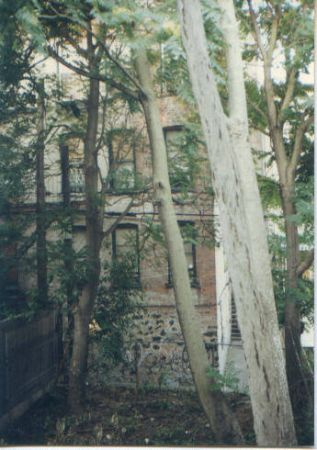 The trees in the backyard
at the beginning.
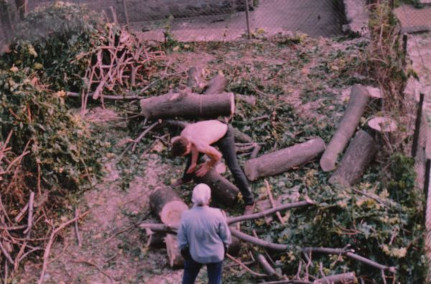
The trees in the backyard being removed.
Over time, another tree grew just outside our fence at the far end of our yard. We asked Linda's brother Larry to cut it down. He was living with us while a pharmacy student at Long Island University. When he started, some of the people who rented space in the building shown in the photo watched Larry from their windows. They must have wondered whether he could actually get the tree to fall safely. But they needn't have worried; it fell perfectly, not touching any of the buildings or other backyard fences. When it landed, we could hear a round of applause.
Finally, after 19 years of living in what was essentially a construction site, the makeover was complete. We accepted the ongoing disruption of our lives because we believed in the outcome. Because of our shared vision, we were willing to live with the filth, several relocations of our bedroom and kitchen, and many other challenges, including my hernias. We lived in that house for a total of 32 years. To see the transformation of the Brooklyn brownstone and its backyard, click here.
Moving to East Taghkanic
Linda grew up in East Taghkanic, New York, an agricultural community in southern Columbia County, which we thought would be a good place to retire. She owned a share of the house, and we bought the other shares from her brothers. We thought we would rehab and expand the old house and engaged the same architect we used in Brooklyn. But rehabbing the house turned out to be impractical, potentially costing more than building new with a far less satisfactory outcome. We began the arduous process of working with the architect to plan a house that would meet our needs and wants, obtain approvals from the Town, demolish the old house, and construct a new one in its place. We were lucky to find an extraordinary general contractor, Don Hoysrad, to make it work. Linda knew every inch of our property, having meandered through it from childhood through adolescence. That sensitivity, love of place, and sense of design produced a wonderful landscape. To see the new house and the surrounding land, click here.
If you looked at the photos, you saw the house up the hill, which is occupied by Linda's brother Larry, his wife Nicole, and his daughter Claire. Our house is, therefore, part of a family compound, which has brought much enjoyment to our lives. Linda has three brothers, and the four spouses, including Nicole and me, are collectively known as the "outlaws." Because we live so close to each other, Nicole and I continually banter. Nicole is fond of buying me T-shirts, which I try to wear when we get together, but I always deny remembering that she gave them to me. She always goes along with the shitik. That became impossible when Nicole, Larry, and Claire lived with us for a year because a garage fire made their house uninhabitable. Nicole and I saw each other almost every day, and I obviously didn't have enough of those T-shirts to keep that routine alive.
I have slowly become comfortable with country living, significant because I spent all my previous years in urban settings. I didn’t just move to the country; I let it work on me. But I worked on it as well. My contributions to beautifying the landscape have included mowing, weeding, weed-whacking, and digging. An entire 48-foot-wide, 4-foot-tall retaining wall in our garden was built with the rocks I extracted from the land.

The Retaining Wall
Being comfortable in the country was not immediate. The first time I drove the tractor we bought, I went over a large tree stump, and the tractor ended up on top of it, swaying like a seesaw. I had to call Linda’s brother, Larry, to move it off the stump. That’s the day I rated myself 9% country, and only that high because I had bought some colorful T-shirts to replace my all-black New York City attire. But I kept working on my transition, and these days I think I'm there.

A Country Boy
What Now?
As I was writing this chapter, what came to mind was the old expression "Live and learn." I made plenty of mistakes with my parents, my first marriage, and my early relationship with my children. I found all of that regrettable and modified my behavior in my second marriage and in my children's later lives. I understood what went wrong and grew progressively wiser. Unfortunately, I came to understand the problematic nature of my communication with my parents too late. I wish I had been able to do better with those relationships.
What I have learned about my past is that I have made, and will continue to make, mistakes. I believe that all mistakes are simply lessons, from which, with patience, humility, openness, acceptance, and effort, if all that is possible, I can grow wiser and become the best I can be.